
On November 15, 2026, Xbox turns 25. Microsoft’s anniversary plans bring back the translucent green, familiar buttons and unmistakable shapes of its first console, alongside a FanFest tour and new community designs. But the best way to understand the celebration is to revisit the enormous black box that started it.
Xbox arrived in 2001 with something to prove. Sony dominated the conversation, Nintendo had generations of goodwill, and Sega was still part of the console landscape. Microsoft did not win that generation in sales. It did help make the hard drive, broadband connection and shared online identity feel like essential parts of a console.
Why the anniversary keeps looking back to 2001
The official anniversary campaign uses the original Xbox’s colors and hardware details to recall a turning point: the moment Microsoft stopped being just the Windows company and became a contender for the television in your living room.
That same year, Windows XP was making the home computer a more welcoming center of digital life. Xbox carried some of that ambition to the couch. It was more than a PC in a different case, though: fixed hardware, a controller-first interface and a machine built around one clear activity gave it a character of its own.

Entering a console war that already had its favorites
Sony was following the success of PlayStation with a machine that played both games and DVDs. PlayStation 2 arrived with enormous anticipation and a compelling place in the living room. Nintendo remained an institution, while Sega’s Dreamcast had shown how exciting a new generation could be. A newcomer needed more than powerful hardware. It needed a reason to exist.
Microsoft made sure you could recognize its answer from across the room. A giant X spread over the console’s lid, surrounding a green circle. The heavy black case made no attempt to disappear into the entertainment center. This was hardware that wanted to be noticed.
The more consequential choices were inside. Microsoft’s November 15, 2001 launch announcement emphasized a built-in hard drive and Ethernet port. Those features sound routine now. At the time, they meant every Xbox was ready to store data and connect to broadband without owners first buying separate storage and networking add-ons.
A big machine with an even bigger personality
The first Xbox was not elegant in a minimalist sense. It was thick, heavy and wide, with four controller ports across its front. Bringing one home meant finding space for the console, its cables, the games and a controller that seemed capable of claiming half the coffee table.
That excess became part of the appeal. Nintendo 64 had already made four-player couch sessions a defining ritual of the 1990s. Xbox took that gathering toward larger 3D worlds, surround sound and matches that could connect more than one console.
Setting it up could feel like preparing an event. Someone moved a television. Someone untangled the cables. Someone produced the game they had bought, borrowed or rented. While a trip to Blockbuster could still decide the weekend’s entertainment, turning up at a friend’s house with an Xbox and four controllers was a plan in itself.
The Duke: too big to forget
The original controller, later widely known as the Duke, immediately became a talking point. Two sticks, colored face buttons, accessory slots and those distinctive black and white buttons filled a shell that was unusually large even beside the console it belonged to.
It did not suit every pair of hands. Microsoft moved toward the smaller Controller S, whose proportions felt closer to the designs that would follow. The change neatly captures the early Xbox personality: make an ambitious first move, listen to the response and turn a correction into the next standard.

Halo gave the box a reason to exist
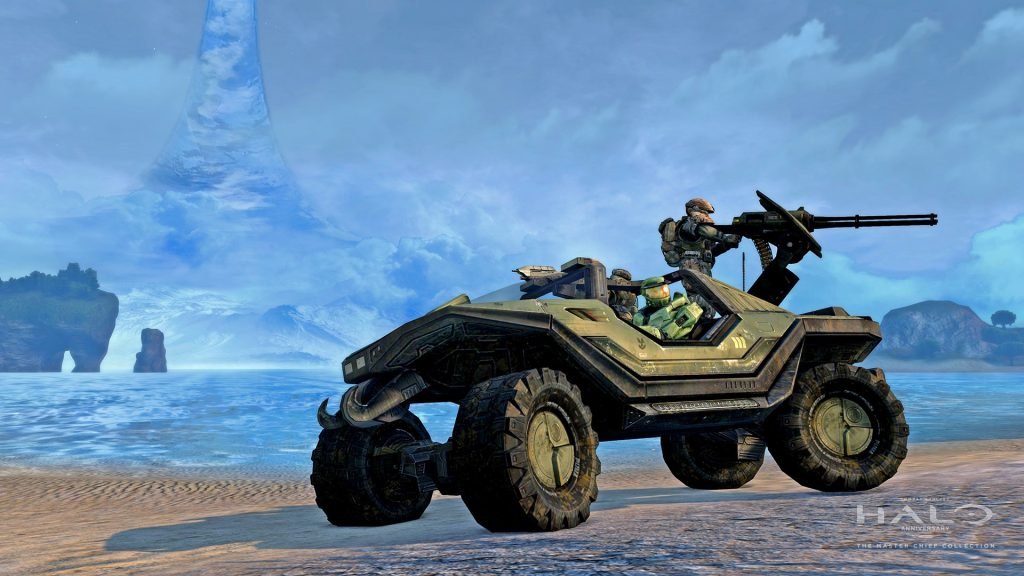
New hardware needs a game that explains why anyone should buy it. Halo: Combat Evolved did that job from launch. It was more than a technical demonstration: its controls, open spaces, vehicles and split-screen play added up to something players could immediately identify with Xbox.
Halo deserves its own history, but its place here is clear. It showed that Microsoft could build a gaming identity rather than simply sell a capable machine. Without it, the console’s bulk, price and newcomer status would have been harder obstacles to overcome.
The initial response was stronger than the underdog story sometimes suggests. Citing NPD figures, Microsoft reported 1.5 million consoles sold in North America between launch and the end of 2001. Xbox had reached that milestone in roughly six weeks, competing with companies that had spent years building their audiences.
The small port that pointed toward the future
Perhaps the console’s most important feature was around the back. Beside the power and video connections sat an Ethernet port. Networking was not a promise reserved for a later hardware revision. Every Xbox had the connection.
Before the online service arrived, that port supported another kind of gathering. System Link let players connect consoles, filling rooms with televisions, extension leads and network cables. A match no longer had to stop at the four people who could share one screen.

Xbox Live made your identity travel between games
Xbox Live launched in the United States and Canada on November 15, 2002, exactly a year after the console. Its starter kit included a year of service, a voice communicator and game trials. The larger idea mattered more than the package: one account could bring together a name, friends, conversation and matches across different games.
The original Xbox Live announcement described players finding one another, competing and talking from the couch. Local play did not suddenly disappear. It gained a companion ritual: put on a headset, check who was online and hear voices arriving from another city.
Live also changed what happened after you brought a game home. In an era when DVDs made a physical package feel like a complete little world, the Xbox hard drive could hold extra content, downloads and saved data. The game still lived on the shelf, but its life could continue beyond the disc.
Xbox did not invent online console gaming
It is worth separating influence from invention. Dreamcast had already included a modem, and PlayStation 2 had online experiences of its own. Xbox’s distinction was the consistency of the whole system.
Microsoft included a hard drive and Ethernet in every machine, required broadband for Live and built the service around a shared identity. Developers and players could count on the same basic capabilities. Online play could be treated as part of the platform rather than a separate experiment that depended on which accessories an owner had purchased.
Over time, many of the surrounding ideas became ordinary: profiles, friends lists, voice chat, achievements, updates, digital stores and libraries tied to an account. The original Xbox did not introduce every item on that list. Its contribution was helping establish the direction in which consoles would move.
Losing the sales race was not the end of the story
PlayStation 2 dominated the generation. Xbox faced real problems, from its size and cost to uneven strength beyond its major exclusives and a more limited international presence. Calling the first Xbox an outright victory would flatten a much more interesting history.
It did pass the test every new platform faces: persuading enough people that there should be another one. When Xbox 360 arrived in 2005, Microsoft had franchises, a community, an online service and a recognizable idea of what a console could be.
That was the black box’s less obvious success. It pushed the industry to take different questions seriously. How does the player connect? What stays with an account? What happens to a game after purchase? Where does the machine end and the service begin?

From a box under the television to a wider platform
Twenty-five years later, Xbox is no longer contained in a single object. It encompasses Series X and Series S, PCs, subscription services, cloud gaming and devices without a green X on the case. That reach would have looked surprising in 2001, even though the original console already pointed toward a networked future.
The first Xbox used hardware as a gateway to a network. The modern platform places more emphasis on the library, account and ability to keep playing. Whether that broadens or dilutes the console’s identity remains a fair subject for debate. The connection to Live’s original promise is unmistakable.
The anniversary campaign captures the tension perfectly. Microsoft talks about playing across devices, then reaches back for translucent green plastic, Duke buttons and the silhouette of a very physical machine. Even a platform that can travel still needs an object people remember.
What the original Xbox changed
The first Xbox made connection part of the console’s foundations. Its hard drive held more than saved games. Ethernet prepared the living room for a much larger group of players. Live let a name and a circle of friends follow you from one game to another.
You do not have to have owned one to recognize the effect. It was not the generation’s best-selling console, and it did not invent online play. It brought several ideas together in a form the rest of the industry could not ignore.
For all the debates that followed, the original machine still offers a wonderfully concrete place to start. Turn it around, find the Ethernet port and remember when a small socket on the back of a very large box looked like an invitation to the future.