
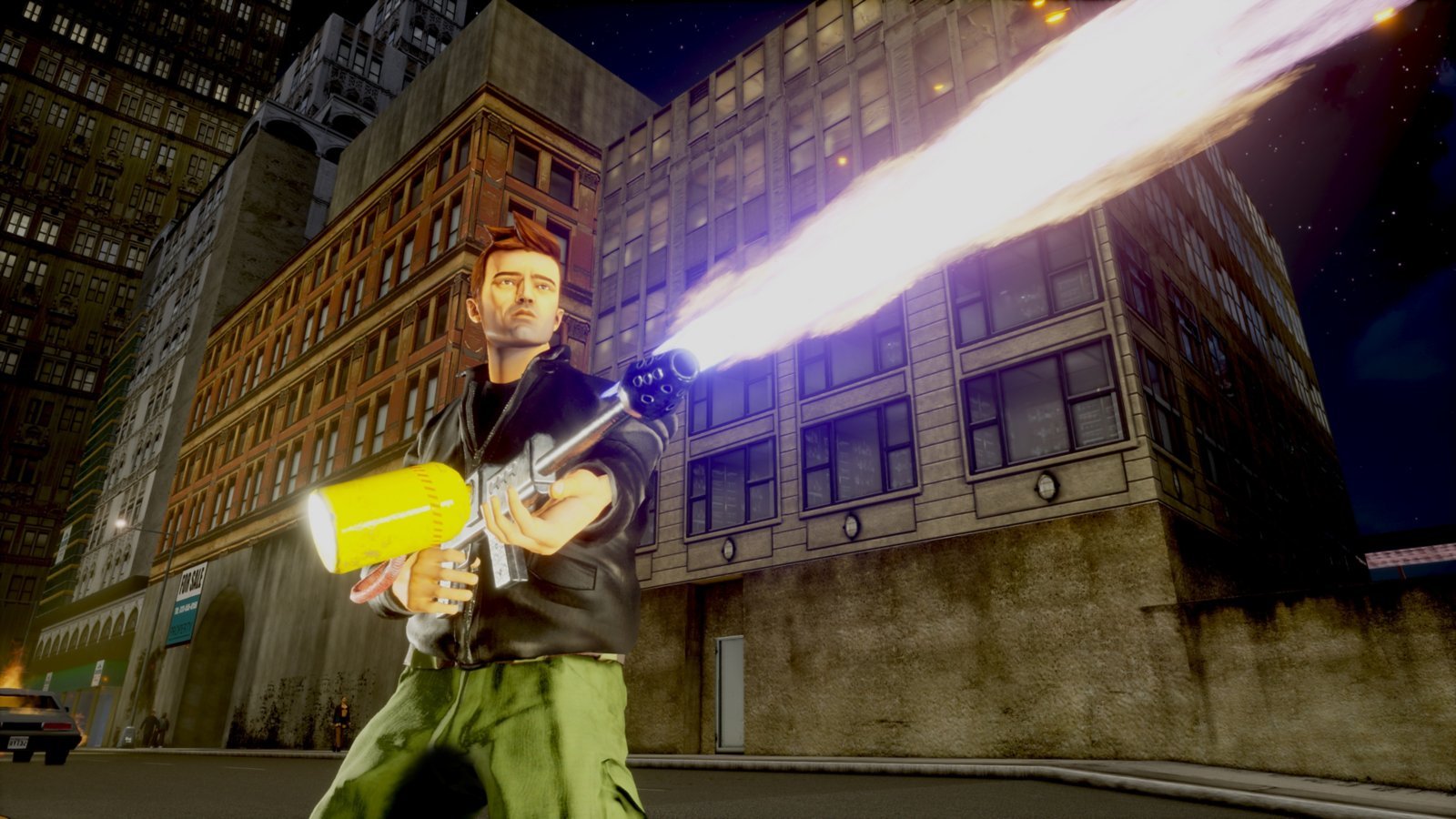
You were supposed to be going to a mission. Then a better car went past, the radio found a song worth keeping on, and a police chase took you into a neighborhood you barely recognized. Half an hour later, the mission was still waiting. Somehow, you had been playing the whole time.
That was the revelation of Grand Theft Auto III. Released for PlayStation 2 in October 2001, it made Liberty City feel like a machine that could keep producing trouble without a script for every encounter. As its 25th anniversary approaches, the remarkable part is how quickly that feeling became something players expected from other games.
GTA III did not invent the open world. It gave an enormous audience a vivid, immediately understandable version of one: a city where a journey could matter as much as the objective at its end.
The first escape left you with a question
The opening wastes little time. A betrayal puts Claude in custody; an attack on a prisoner transport gives him a way out. Soon he is loose in Portland, the first of Liberty City’s three main islands, with somewhere to save and a contact offering work.
Then the game loosens its grip. You can follow the marker, but you can also take a taxi, find a ramp, change stations or drive until an unfamiliar street becomes a dead end. These are not separate modes selected from a menu. They happen in the same space, and they can interrupt each other.
The difference sounds ordinary now because so many games absorbed it. In 2001, being allowed to lose the plot for a while was itself part of the attraction.

A city made from things that collided
Earlier games had already offered exploration, urban routines and freedom. The first two GTAs supplied the overhead blueprint. Driver built its appeal around city streets and car chases; Shenmue gave everyday places a detailed rhythm. Nintendo 64 adventures had helped make navigating three-dimensional spaces familiar.
GTA III brought driving, on-foot action, traffic, pedestrians, police, radio and a crime story into one persuasive package. Its systems were simple enough to understand individually and unpredictable enough to become interesting together. A stolen car was transport, a weapon, an escape plan and a terrible place to be when its engine caught fire.
The Strong inducted GTA III into its World Video Game Hall of Fame in 2016. That recognition fits a game whose influence reaches well beyond the boundaries of its own series.
You learned Liberty City by getting lost
Portland, Staunton Island and Shoreside Vale gradually opened as the story progressed. They had different textures: industrial yards and narrow streets, business districts and tall buildings, then roads that spread into airport and suburban territory. They felt like parts of a city rather than a succession of levels.
You learned their routes through small disasters. A late turn revealed a shortcut. A failed jump explained why that patch of water was a problem. A police chase taught you which bridge was a bottleneck. Repetition built a mental map long before navigation systems began drawing a glowing line through every modern open world.
That knowledge belonged to the player. Knowing how to get somewhere could feel like a skill, and recognizing a street after a chaotic detour gave the city a sense of permanence.

Every car came with a little world inside
Getting into a vehicle also meant inheriting a soundtrack. Hip-hop, trance, reggae, pop, classical music and absurd talk radio gave each trip a different mood. The fictional advertisements and presenters made the stations feel as if someone in Liberty City might actually be listening to them.
You could change cars because you needed something faster and end up discovering a song. You could also reach your destination and refuse to get out until a segment finished. The radio turned the space between missions into something with its own entertainment value.
This was an especially effective kind of world building because it arrived through an action you were already doing. The game did not stop to explain the city’s culture. You heard it while driving badly through it.
Claude left room for the city
Claude’s silence is one of GTA III’s defining oddities. Criminal employers talk at him, betray him and send him into danger; he responds by getting on with the job. Later GTA protagonists would bring far more conversation and personality to the foreground.
Here, the quiet center leaves room for everything around him. The radio hosts, crime bosses and pedestrians supply a noisy social world, while the player supplies the impulse to take one more detour. Claude can feel like an empty space, but that space is useful to the game’s particular kind of freedom.
It also makes Liberty City the strongest recurring personality. You may forget the order of individual jobs while still remembering how a certain neighborhood felt after dark.
The side trip became the story
A taxi could start passenger work. An ambulance turned familiar roads into an urgent route-planning exercise. Police vehicles opened vigilante jobs. Hidden packages, stunt jumps and races provided other reasons to inspect the map instead of simply crossing it.
None of those activities needed to be your original plan. You could set out to advance the campaign and end up trying to survive a wanted level in a car that had lost most of its useful parts. The resulting failure was often more memorable than the mission you had intended to begin.
That is one reason the phrase “nothing happened” barely applied to a GTA III session. Even an evening without campaign progress could leave you with a story about traffic, luck and a spectacularly poor decision.

It belonged to the PS2 living room
GTA III arrived during an extraordinary period for PlayStation 2. The machine combined a rapidly expanding game library with DVD playback, making it a tempting centerpiece for the television. A black console, a disc case and a memory card could organize an entire weekend.
Discovery was physical, too. A magazine screenshot, a friend’s description or a rental shelf could start the conversation. The trip to Blockbuster belonged to the experience just as surely as loading a save. Sometimes the most urgent objective was fitting enough play into the hours before the game had to go back.
Those circumstances helped turn Liberty City into a shared reference. People could describe completely different evenings spent in the same place, and everyone else understood the possibilities.
The industry inherited a new set of expectations
After GTA III, a visible car or a distant street seemed to invite a question: can I use it, or go there? The game’s influence was not simply that other studios built cities with mission markers. It encouraged the idea that the world between objectives should offer opportunities of its own.
The series itself moved quickly. Vice City followed in 2002 with a voiced protagonist and a strong 1980s identity. San Andreas expanded the territory and the range of activities in 2004. Returning to GTA III makes its relative spareness obvious, but that also makes the foundation easier to see.
Its most durable lesson is that a system can generate a surprise a scripted sequence cannot. Give traffic, pursuit, geography and an impatient player enough room, and something will happen.
Returning means meeting its rough edges again
The controls, targeting, camera and mission restarts can feel unforgiving now. Some journeys require more repetition than a modern game would ask for, and the city is smaller than childhood memory may have made it. Nostalgia does not remove those limitations.
The updated version included in Grand Theft Auto: The Trilogy – The Definitive Edition offers another route back. It is a remastered edition of the older game, so the underlying structure still comes from 2001. Choose it expecting to revisit that design, not to find a newly built contemporary GTA hiding inside the old map.

From Liberty City to the next horizon
As of October 7, 2026, Rockstar lists GTA VI for November 19, 2026. Its Vice City and wider state of Leonida carry a much larger set of expectations than GTA III faced. Players study the streets and neighborhoods before they can even explore them.
The connection is not that a new game needs to repeat 2001. It is that Liberty City helped teach us to look at a digital city as a collection of possibilities. A quarter-century later, that first impulse still makes sense: take a car, choose a station, and see what happens on the way.


Shared memories