
Before you entered the castle, there was the small matter of running around outside it. You could climb a tree, dive into the water, circle the courtyard or simply make Mario turn around because watching him move in three dimensions still felt new. The adventure could wait a minute.
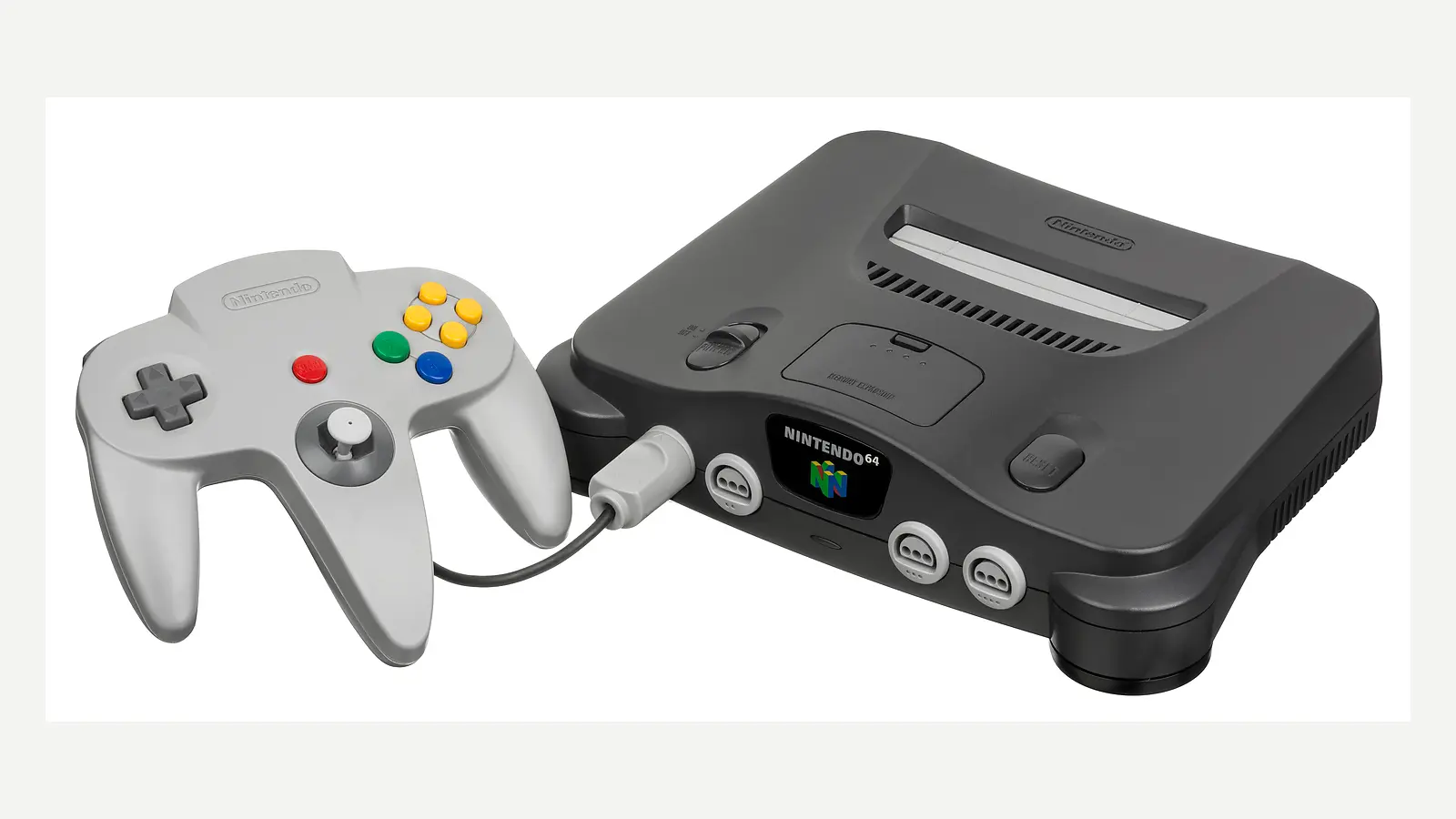
Nintendo 64 arrived in 1996 at a moment when games were learning how to make three-dimensional spaces understandable. It brought a controller that looked as if it required an extra hand, four sockets for multiplayer and cartridges in an increasingly disc-shaped world. It also brought Super Mario 64, an exceptionally persuasive answer to the question of what all that new hardware was for.
The machine’s history contains inspired decisions, expensive compromises and a library with an unusually strong personality. It is also a history of sofas, borrowed cartridges and the person who kept looking at your corner of the screen.
Before the N64, there was a promise called Project Reality
Nintendo entered the 1990s with enormous experience in two-dimensional games. The next transition asked for something different: hardware that could construct and move around spaces instead of simply scrolling past them.
Its collaboration with Silicon Graphics began under the name Project Reality. Ultra 64 came next, before the machine settled on Nintendo 64. Each name reflected an era when technical claims occupied almost as much magazine space as the games themselves.
The number on the box mattered to the sales pitch. Players had already lived through 8-bit and 16-bit rivalry, so 64 sounded like an argument you could win before anyone switched the console on. In practice, a processor label could not tell you how good a game would be. The better demonstration was waiting beside Peach’s castle.
Mario made a new kind of movement feel natural
In a side-scrolling Mario game, moving forward usually meant moving right. Super Mario 64 replaced that certainty with depth, distance and a camera. Suddenly you had to judge where a platform existed in space, not just when it passed beneath your feet.
The castle grounds gave you room to learn without making the lesson feel like homework. Move the stick gently and Mario walks. Push farther and he runs. Experiment with jumps, get the distance wrong, then try again. The environment makes the control scheme understandable through use.
The game was not the first 3D game, but its combination of responsive movement, playful spaces and a familiar character made the transition unusually welcoming. It helped turn a technological novelty into a way people expected an adventure to feel.
That controller was solving two problems at once
The three handles still provoke a reasonable first question: where do your hands go? The answer depends on the game. Holding the center and right grips puts the analog stick beneath your left thumb and the Z trigger beneath your finger. The left grip and directional pad remain available for another style of control.
The arrangement reflects a period when the future had not fully replaced the past. Nintendo wanted a controller suited to analog movement without abandoning the familiar directional pad. The shape was strange because the transition was strange.
Nintendo’s hardware history emphasizes the Control Stick and the system’s multiplayer design. Analog controls had existed earlier, but the N64 helped make the thumbstick a normal part of console gaming. The three-pronged shape did not become the standard; the importance of sensitive directional movement did.

Four sockets changed what a living room could do
The front of the console made a direct promise: four controllers could plug into the machine without a separate multiplayer adapter. You still needed the extra controllers and a suitable game, but the possibility was visible every time you looked at the hardware.
Mario Kart 64 made that promise wonderfully obvious. Races could swing from triumph to disaster in seconds, and Battle Mode gave everyone a reason to treat a small colored balloon with extraordinary seriousness. The competition was immediate because your rivals were in the room.
GoldenEye 007 supplied another version of the same magic. Four quarters of a television became four private territories that everybody could see. Arguments about screen watching were inevitable. So were house rules, favorite maps and the suspicion that one particular character gave somebody an unfair advantage.
The machine was social in a very physical way. You knew who had beaten you because they were laughing within arm’s reach. The game could end, but the discussion usually continued.
Cartridges were a strength with a substantial cost
While PlayStation and Saturn used CDs, Nintendo stayed with cartridges. The format offered quick access to game data and a sturdy object you could carry between houses. Putting one into the slot and switching on had a satisfying directness.
But cartridges also offered far less storage than CDs and could be expensive to manufacture. Developers trying to fit extensive video, recorded speech or large amounts of music had difficult choices to make. Nintendo’s decision affected which projects reached the system and how those games were built.
It is too simple to describe the choice as wholly right or wholly wrong. The speed suited some of the N64’s best experiences. The capacity and production constraints made the platform less attractive for other kinds of games. Players felt both consequences: wonderful individual releases and a smaller overall selection than PlayStation offered.
The physical format also fit the rental culture surrounding it. A Friday visit to Blockbuster could produce a cartridge that determined the entire weekend. Returning it was much harder emotionally if you had just discovered one more thing worth trying.
Rare helped give the machine its voice
Nintendo supplied much of the system’s identity, but Rare was essential to its character. GoldenEye, Banjo-Kazooie, Diddy Kong Racing, Perfect Dark, Donkey Kong 64, Jet Force Gemini and Conker’s Bad Fur Day did not all appeal to the same audience. Together, they made the library feel broader and more adventurous.
Rare could turn exploration into a dense collection of secrets, bring a distinctive sense of humor to a platformer or make a console shooter the centerpiece of an evening with friends. Its games often felt like events on a system where the gaps between major releases could be noticeable.
For many players, remembering Nintendo 64 means remembering Nintendo and Rare in almost the same breath. The console’s personality is difficult to separate from that partnership.
Zelda taught the camera to pay attention
The Legend of Zelda: Ocarina of Time faced problems different from Mario’s. How should a player fight an enemy in three dimensions while also managing movement, distance and the camera?
Z-targeting helped organize that encounter. Locking onto an enemy kept Link oriented around a recognizable point, making circling, defending and attacking easier to read. The result made a complicated spatial problem feel like a conversation between the player and one opponent.
Released in 1998, Ocarina became one of the system’s defining adventures. Alongside Mario, it demonstrated how much the era involved inventing practical solutions to problems that a flat screen full of sprites had never needed to pose. Those solutions became familiar enough that it is easy to forget how new they once felt.
The controller could grow attachments
The accessory slot gave the controller a second life. A Controller Pak stored data for compatible games. The Rumble Pak, closely associated with Star Fox 64, added vibration. The Transfer Pak connected supported Game Boy cartridges to compatible N64 software.
These were different tools for different jobs, even if they all made the controller look a little more complicated. A shaking pad helped a collision feel physical. A transfer accessory could make the creatures you had raised on a small handheld appear on the television.
The console itself had an upgrade slot, too. Replacing the Jumper Pak with an Expansion Pak added memory for software that used it. Some games offered enhancements; others required the accessory. The original Donkey Kong 64 manual makes that requirement explicit.
It was a particular kind of late-1990s excitement: discovering that a game needed a small physical upgrade, then opening a cover on the console to make room for it.
Pokémon, parties and increasingly loud afternoons
Pokémon Stadium offered the spectacle of seeing familiar creatures battle in 3D. Pokémon Snap found a completely different pleasure in observing and photographing them. The N64 helped show that a series associated with Game Boy could support more than one kind of experience.
Super Smash Bros. took another familiar playground conversation—who would win in a fight?—and gave it a rule set. Mario Party turned a board game into an excuse for a succession of competitions and reversals. The first game’s strenuous stick-spinning activities are also a reminder that not every multiplayer idea aged gracefully.
The common thread was the room. The same console could support a long solitary adventure or an afternoon of noise, accusations and requests for one more round. Its four ports were not a decorative feature. They shaped its reputation.

A colorful object with visible limitations
The original dark console eventually acquired translucent siblings. The Funtastic colors captured a moment when technology wanted to look playful and let you glimpse its insides. Even sitting beneath a television, an N64 could announce the decade it belonged to.
The games have their own unmistakable period texture: soft surfaces, fog, angular faces and cameras still learning their job. Some of that looks charming now; some of it remains awkward to play around. Affection does not require pretending the hardware solved every problem.
Nor did critical influence mean commercial domination. Nintendo records 32.93 million N64 consoles and 224.97 million software units. That was a substantial audience, but Sony’s PlayStation reached far more households.
The worlds stopped feeling flat
Nintendo 64’s influence is easier to see in habits than in a sales ranking. Sensitive thumbstick movement, four-player living-room sessions, camera-aware combat and the pleasure of exploring a fully navigable space became part of gaming’s ordinary vocabulary.
The console also preserved a very specific rhythm. Insert a cartridge, find a controller and begin. If you wanted another person to join, they often needed to be in the house. If you wanted a new game, you went looking for a physical object.
The details could be inconvenient. The memories could be extraordinary. For players who first ran circles around Peach’s castle or discovered just how personal a four-player race could become, Nintendo 64 marks the moment a game world gained depth—and the living room got a little louder.



Shared memories