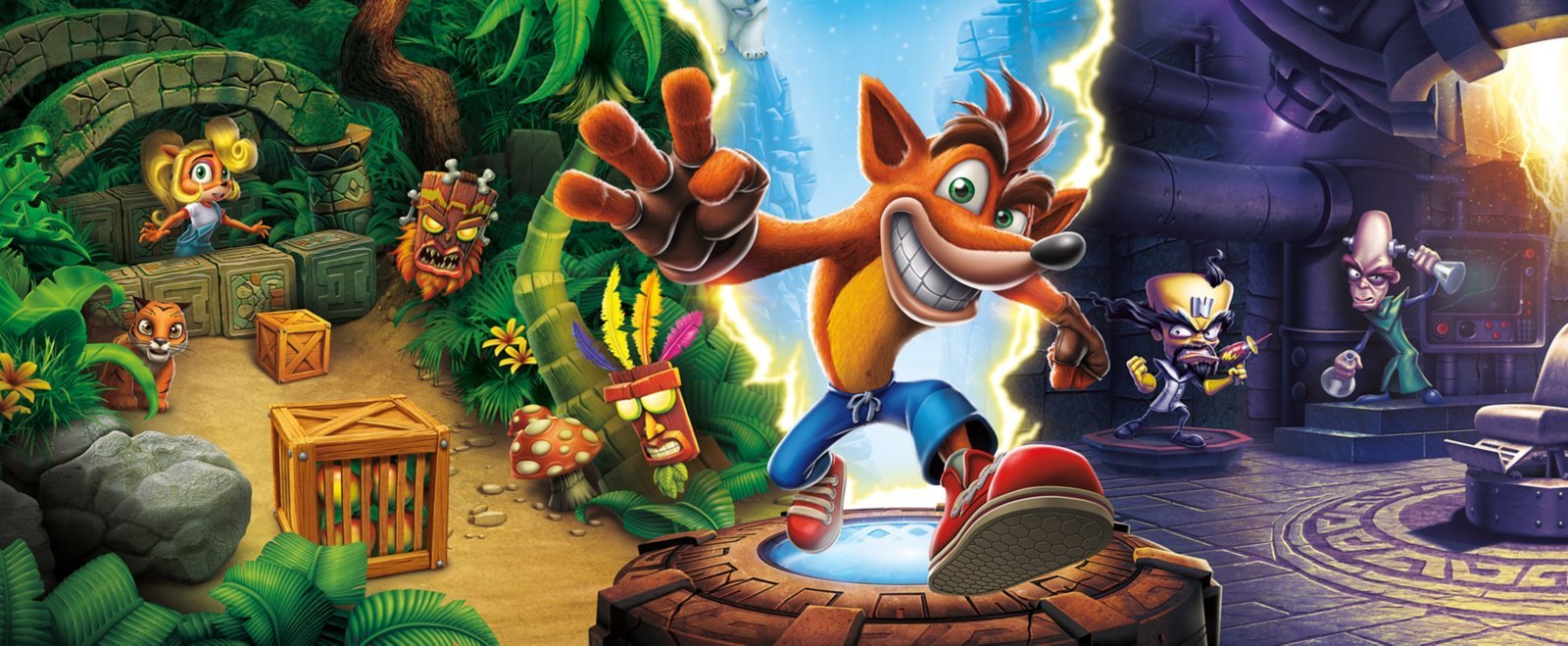
Crash Bandicoot could communicate his personality before he completed a level. The eyebrows, grin, spin and total inability to leave a crate intact made him easy to recognize. On a magazine page or television commercial, that mattered almost as much as what happened after someone picked up the controller.
Thirty years after his 1996 debut, the original Crash is worth revisiting as a design problem with a wonderfully specific answer. Naughty Dog did not make a small version of Super Mario 64. It built a different kind of three-dimensional platformer, using controlled viewpoints and carefully arranged routes to make an unfamiliar space readable.
A character who could explain PlayStation’s attitude
PlayStation already had games, technology and an expanding audience. A memorable character could give those things a face. Mario and Sonic demonstrated how quickly a silhouette could become shorthand for an entire platform; Crash offered a more unruly expression of that idea.
Naughty Dog president Evan Wells recalled that the first game was made by eight people. His retrospective also places Crash’s public debut at E3 1996 and describes the rapid pace of the sequels. The finished game can make the operation seem much larger than that number suggests.
The original release began in North America in September 1996, with other territories following. This retrospective concerns the original game’s design and later influence; it does not treat anniversary speculation as evidence of an unannounced sequel.

The camera turned a limitation into a style
Crash often moves along a route extending into the screen. Elsewhere, the game swings into a side-on view or sends him running toward the player with danger close behind. These shifts let the designers organize obstacles around a controlled perspective rather than ask the player to manage an unrestricted camera.
That decision changes what a level can emphasize. An enemy, pit and landing spot can be arranged as a readable sequence. A pursuit can frame Crash’s expression while the player judges the next jump. The background can look dense because the game does not have to expose every angle of it at once.
It also produces weaknesses. Reading depth with a digital directional pad can be difficult, and the view sometimes hides information you would like to have. Those are not reasons to dismiss the design; they are the tradeoffs that explain its distinctive rhythm. Crash feels like a carefully staged obstacle course, while Nintendo’s early 3D adventures often invite more open exploration.
Why the crates mattered more than another enemy
In his firsthand development account, Andy Gavin describes levels that needed more activity without a large increase in graphical complexity. Crates supplied an economical answer. They could hold rewards, stack, bounce, explode and combine into small decisions.
A simple object became a system. Spinning was useful, but not always correct. A tempting box might make the next jump harder; TNT asked for a different response from an ordinary crate. The player learned to recognize a visual cue and adjust an action quickly.
The crate tally gave a level a second purpose. Reaching the end did not necessarily mean you had understood or explored everything. The missing box became a tiny unfinished argument with the game, enough to make a familiar route worth attempting again.
Gavin’s recollection connects the crates to the character’s eventual name. That origin fits the finished game: Crash’s identity and its central action reinforce each other. The thing he does most often is also the thing that makes him memorable.
The difficulty lived in your hands
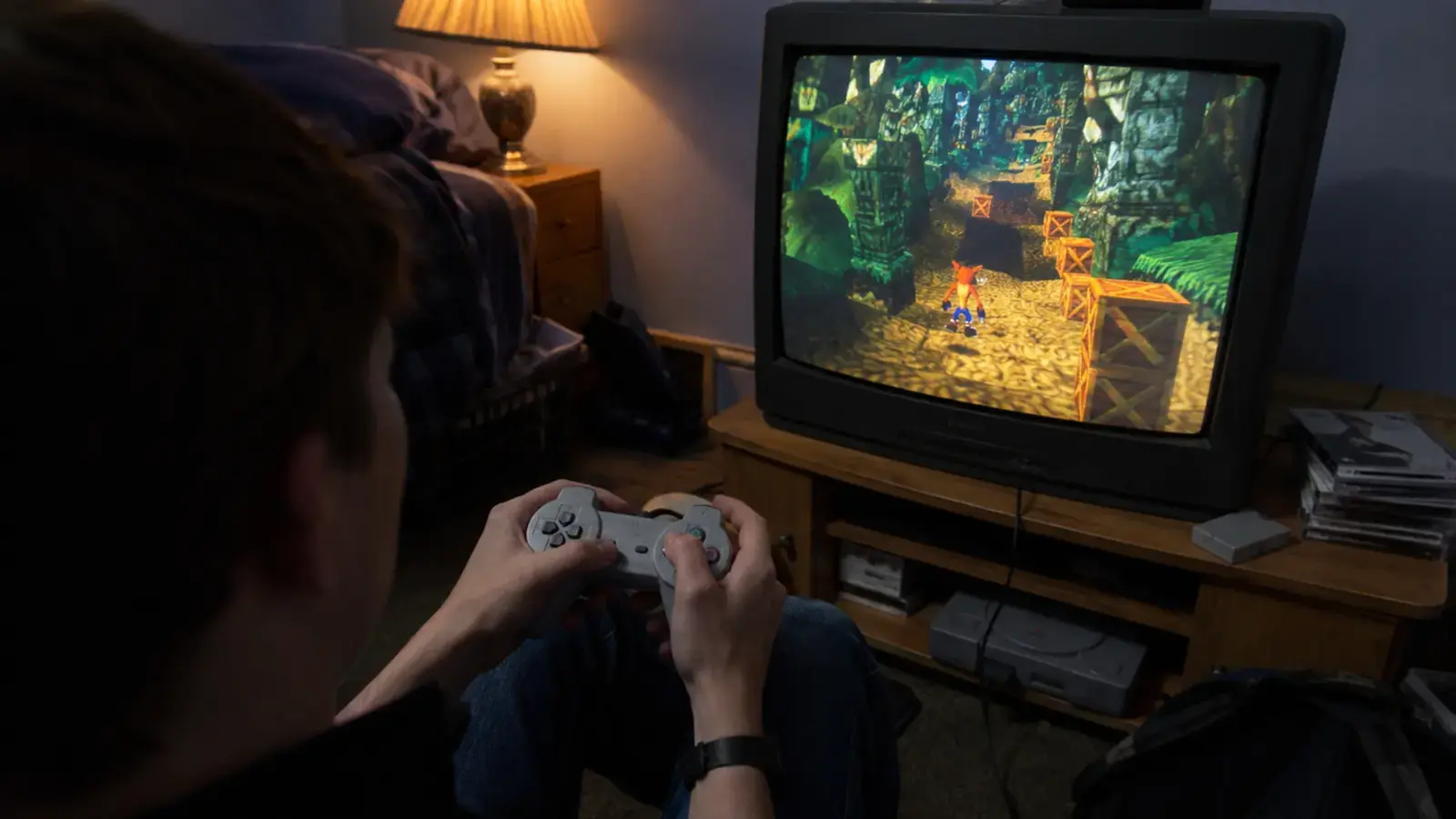
The original game predates the analog sticks that later became a standard part of PlayStation controllers. Moving through depth with a directional pad could feel exacting. A bridge, a narrow landing or a pursuit sequence demanded confidence built through repeated attempts.
Saving also required more attention than modern automatic checkpoints. Bonus stages and the conditions around completion became part of planning a session, rather than something a player could assume would happen in the background. The result could be satisfying or irritating depending on how the evening was going.
A retrospective does not need to treat every frustration as a virtue. The difficulty is meaningful when it asks you to understand timing and space; it is less appealing when the viewpoint makes a failure hard to interpret. Both experiences belong to the memory of the first Crash.
What survives is a familiar physical response: leaning forward, pressing a direction harder than the controller can register and insisting that the next attempt will be the last. The design makes failure quick enough to invite that promise repeatedly.
The unofficial mascot was not a Sony-owned character
Crash’s close association with PlayStation can obscure the ownership story. Naughty Dog developed the original games through its relationship with Universal Interactive, and Sony published them on PlayStation. The character was not simply a Sony property, which helps explain why later Crash games could appear on other companies’ hardware.
The advertising nevertheless made the rivalry feel personal. The famous costumed Crash and megaphone campaign presented the character as a noisy challenger. It fit the game’s expressions and slapstick: this was a mascot who seemed more likely to knock something over than politely explain the specifications.
That image was effective because it could survive outside gameplay. A viewer did not need to know the game’s islands, villains or completion rules to recognize the attitude. The character gave a complicated moment in the console market a very simple visual argument.

The return had to rebuild more than the graphics
Crash Bandicoot N. Sane Trilogy brought the original three adventures to PS4 in 2017, developed by Vicarious Visions. Activision’s release announcement identified June 30 as the launch date. The collection subsequently reached additional platforms.
Revisiting Crash through that collection is not identical to playing the original discs. Presentation and systems were rebuilt, and changes in movement or collision can matter in a game about precise jumps. A familiar route can therefore feel both recognizable and subtly different.
The renewed series also included Crash Team Racing Nitro-Fueled and Crash Bandicoot 4: It’s About Time, both represented on the official franchise site. Their existence demonstrates that the character’s appeal extended beyond one console generation. It does not mean every entry has the same strengths.

Thirty years later, the next crate still works
Crash’s history is full of business changes, new teams and changing expectations. The original game’s essential invitation remains easy to explain: follow the route, judge the jump, break the crate and try to carry the rhythm into the next obstacle.
That clarity is why he still reads well at thumbnail size and why a short gameplay clip can bring back a very specific sensation. The character and the action are almost inseparable. You see the spin and know what it is for.
In 1996, those decisions helped give PlayStation a recognizable personality. Today, the most revealing way to revisit the game is to notice how much personality emerged from practical constraints: a controlled camera, a small team, limited resources and a box that was inexpensive to draw but satisfying to destroy.