
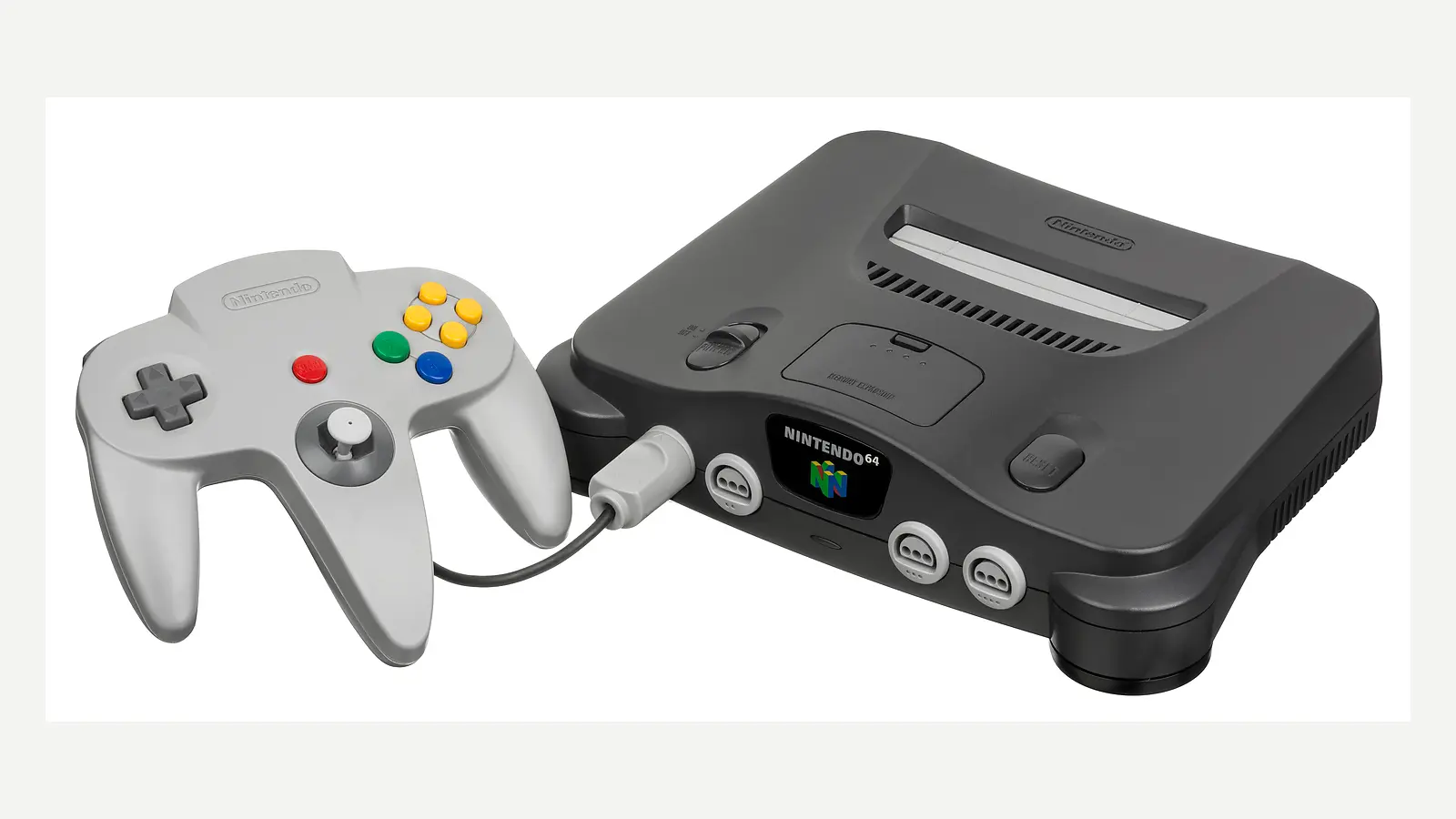
Before the Nintendo 64 had a library, it had a promise: the space inside a television could become somewhere you moved through. Its first year offered relatively few cartridges, but several made that promise feel real. A thumb on an analog stick could steer a jet ski across a wave, guide a pilot toward a landing or send Mario running around a castle simply because running felt good.
These are our five essential Nintendo 64 games with an original release in 1996. That qualification matters. Mario Kart 64 reached Japan that December; players in North America and Europe got it in 1997. This is a look at the console’s first calendar year across regions, rather than a reconstruction of one country’s Christmas shopping aisle.
What counts as a 1996 Nintendo 64 game?
Our selection weighs playability, influence and how clearly a game captures the excitement of early 3D. It is an editorial ranking, not a sales chart. Later favorites such as GoldenEye 007, The Legend of Zelda: Ocarina of Time and Super Smash Bros. belong to other chapters of the console’s story.
The Nintendo 64 launched in Japan on June 23, 1996, as Nintendo’s hardware history records. North America followed that September, while Europe waited until 1997. The different schedules are part of the memory: a magazine could make a game feel familiar months before it reached your local store.
5. Pilotwings 64: room to breathe
Pilotwings 64 was an unusual way to introduce new hardware. Instead of sending a famous character toward a villain, it asked you to learn how to fly. Hang gliders, rocket belts and gyrocopters made distance, momentum and careful landings the point of the experience. Nintendo confirms that it was one of the two North American launch games, alongside Super Mario 64.
The appeal was not just reaching a target. An island could become familiar from above: the coast you overshot, the landmark you used to line up an approach, the patch of ground that looked inviting until you descended too quickly. Birdman gave that curiosity more freedom. Exploring could be its own reward, even without a dramatic story explaining why you were there.
It takes patience now. Controls that once felt like a glimpse of the future can feel demanding, and the mission structure is slight beside later simulation games. Yet its calmness remains distinctive. A successful landing delivers satisfaction without needing a boss fight, an explosion or another unlock notification.

4. Star Wars: Shadows of the Empire: the living-room spectacle
For many players, the Battle of Hoth was enough to sell the idea. Snow, enormous walkers and a snowspeeder made the television look like a place where a familiar movie sequence could finally respond to your hands. Shadows of the Empire arrived in North America in December 1996 as part of a broader Star Wars project connecting games, books, comics and other releases.
Its ambition was also its weakness. Flying, shooting and moving through ground-based levels do not all feel equally convincing. The camera can make simple movements awkward, and some encounters demand more tolerance than their spectacle earns. It sits below the top three because remembering its best moments is sometimes easier than replaying everything between them.
Still, the game belongs here because it captures the demonstration culture around a new console. You did not always show visitors your most elegantly designed game. You showed them the sequence that made someone lean closer to the screen. Shadows understood that kind of occasion.
3. Wave Race 64: the track moved beneath you
Wave Race 64 made water an active participant. A wave changed your approach, lifted the craft and altered the moment when you could turn. Racing meant learning the course and learning what the surface was doing this time around.
The buoy system gave that movement a clear purpose. You had to pass on the correct side, preserve your rhythm and avoid turning a promising run into a string of penalties. A course was more than a blue road with scenery beside it. The water kept interrupting the plan in ways you could read and gradually anticipate.
Nintendo’s description of the original game emphasizes its physics and distinctive buoy-based racing. That is still the useful way to approach it. The textures have aged; the relationship between a thumb movement and a craft pitching through a wave remains remarkably expressive.

2. Mario Kart 64: four corners of one television
Mario Kart 64 began in Japan in December 1996, before its 1997 Western releases. The distinction keeps the list honest without excluding one of the clearest demonstrations of what the Nintendo 64’s four controller ports were for.
The transformation was social as much as graphical. Four players could sit down for races or Battle Mode without purchasing a separate multitap. The screen shrank into quarters, but the room grew louder. A well-timed shell became a personal grievance. Losing a balloon could produce an argument that lasted until the next round.
The game has rough edges: opponents can feel elastic, some tracks are more interesting to remember than to drive, and a crowded split screen gives each player less visual information. Those limits belong in an honest appraisal. They do not erase the immediacy of choosing a character, understanding an item and demanding a rematch.
Our Nintendo 64 history looks more closely at the hardware decisions behind that ritual. Here, the result is simple: a console accessory became an invitation to bring three other people into the game.

1. Super Mario 64: movement became the attraction
The castle grounds explain the achievement before the first painting does. Run in a circle. Climb a tree. Jump, turn, slide and try again. Mario’s movement makes an empty patch of space interesting because the character feels responsive enough to experiment with.
Super Mario 64 did not invent three-dimensional games. Its importance lies in how coherently it combined analog movement, a movable viewpoint, readable spaces and goals that encouraged return visits. A level could be a location you learned, rather than a corridor you completed once.
The camera still causes trouble. Some stars ask for precision that the viewpoint does not always support, and repeated visits can expose a world’s limitations. Calling it influential does not require pretending those problems disappear. It means recognizing how often later games adopted and revised its solutions.
There is also pleasure here that survives its historical significance. Chaining jumps, redirecting a run or spotting a route through a familiar area can still be absorbing. You do not need to imagine yourself in 1996 to understand why the movement mattered.

Five different answers to the same new question
The first Nintendo 64 year was not one unified design breakthrough. It was a set of experiments. Pilotwings offered space and calm. Shadows offered spectacle. Wave Race made a surface feel alive. Mario Kart filled a room with competition. Mario made moving through a world feel like an activity worth doing for its own sake.
That variety is why the small early library still rewards a closer look. These games reveal both the possibilities and the friction of a medium learning new habits. The awkward camera, missed landing and disastrous corner are part of the experience, alongside the moment when your hands finally understand what the screen is asking.



Shared memories