
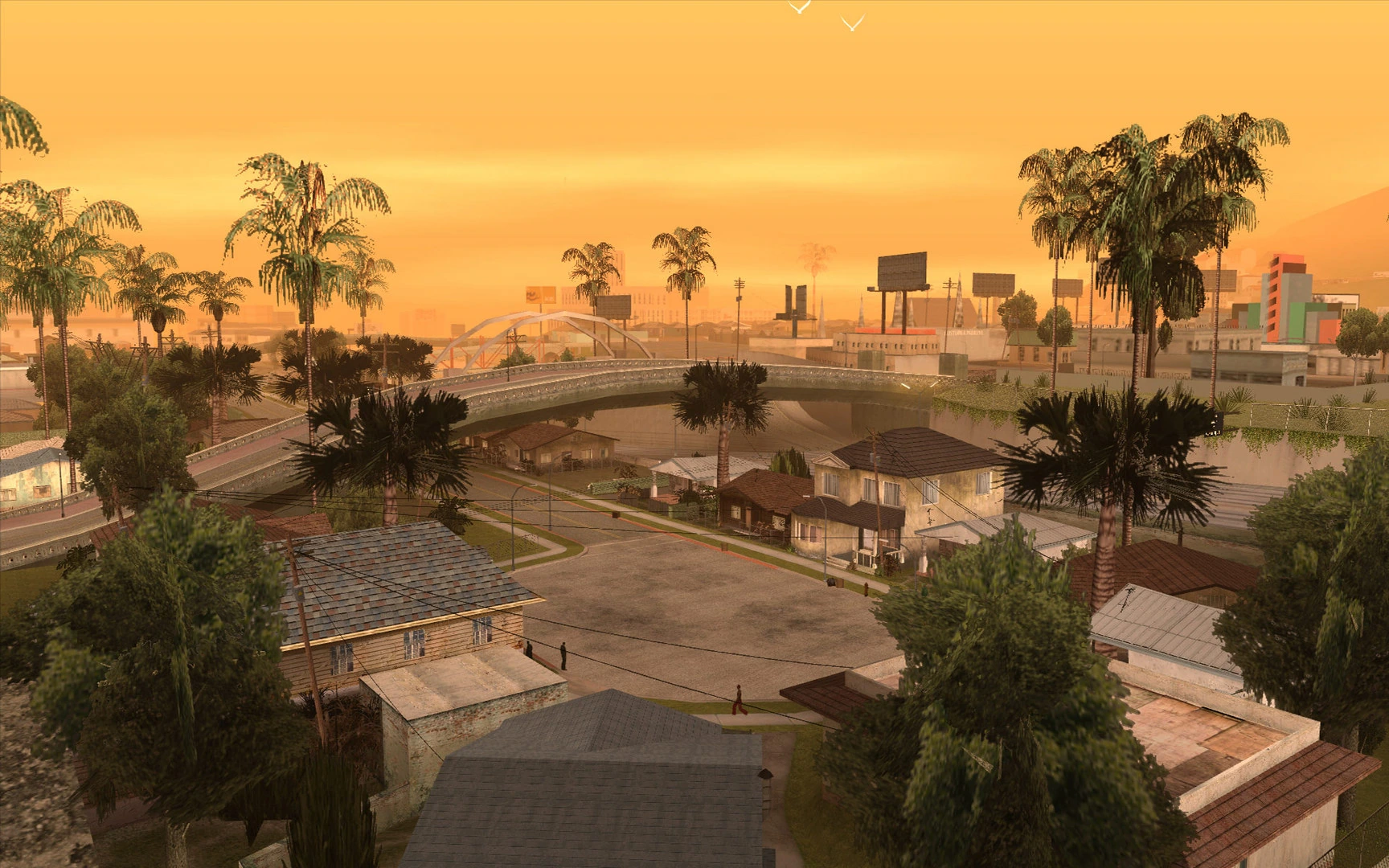
Cover: Original GTA San Andreas screenshot, © Rockstar Games / Take-Two Interactive; archive image via Grand Theft Wiki. Image source.
You can cross an entire state in Grand Theft Auto: San Andreas, yet the place that stays in your head may be a short street with nowhere to drive through. A curve of asphalt. A railway bridge. Houses close enough to recognize before their doors come into view.
Grove Street feels like home because the game makes it a place of return. Family history, useful routines and a recognizable shape all point back to the same block. The larger CJ’s world becomes, the more that small starting place has to carry.
This is a reading of the original 2004 game’s setting and structure. The opening premise is discussed throughout; a clearly marked section near the end contains later-story spoilers.
CJ comes back before the player knows where home is
Rockstar’s official synopsis begins with Carl Johnson returning after his mother’s murder. He has been away, his family is fractured, and the neighborhood has continued without him. Arrival already carries an obligation.
That creates an effective mismatch. CJ knows the street; a first-time player has to learn it. The character is being judged against a history the player has not lived. Getting comfortable with the place becomes part of understanding why everyone expects more from him.
The early journey home also establishes a practical distinction between being in Los Santos and belonging somewhere in it. A city can be full of icons while offering no emotional direction. Here, one address matters before the map has become familiar.
SIGNAL LAB / READ THE SCENE
Read the block in three passes
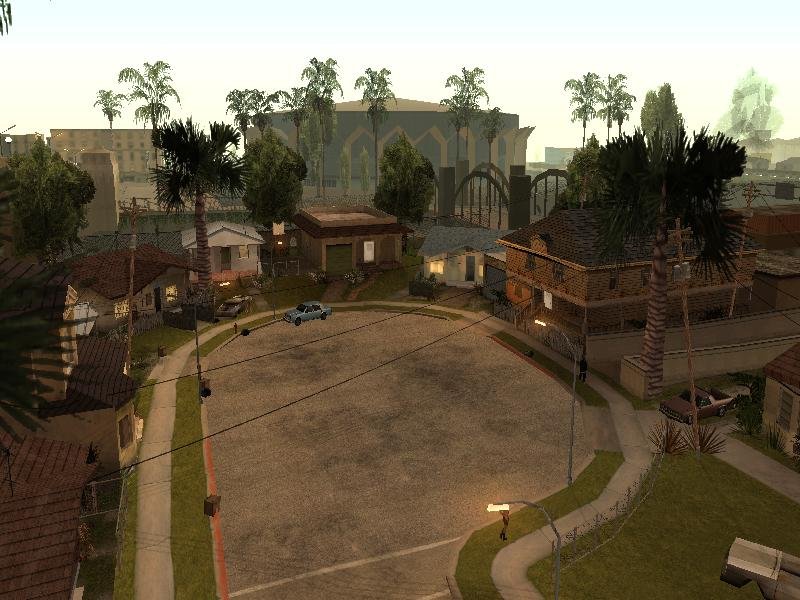
Look at the street, then open a note. Each points to something visible in this original-game image.
1. Start with the circle
The road turns back on itself. It gives the block a gathering space and a recognizable end, rather than making it another road to pass through. Your arrival has a visible destination.
2. Look at the houses around it
Low buildings face the shared road. Doors, porches and short paths keep the scale close to a person on foot. The important relationships occupy nearby addresses, not a list of distant mission icons.
3. Find the bridge behind the block
The elevated railway and its arch give the neighborhood a silhouette. A large landmark helps you recognize a small place. You can remember the approach even after the camera turns away from the street.
A safehouse becomes a routine
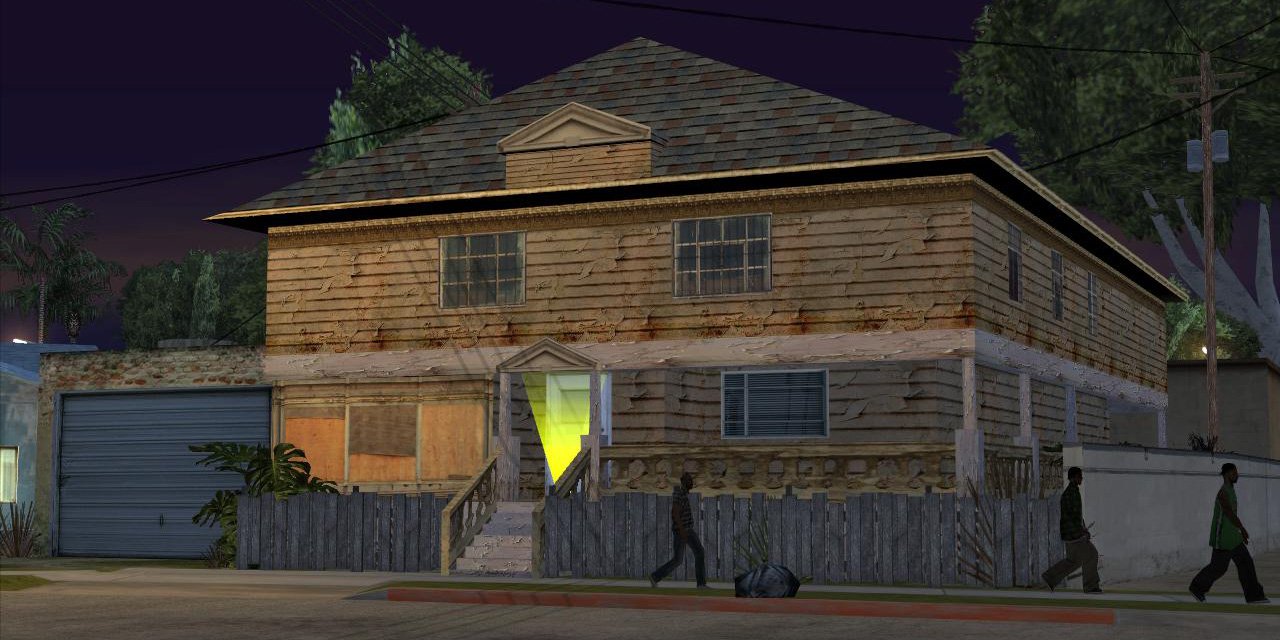
The Johnson house has practical uses: entering, saving progress, changing clothes and using the garage give you reasons to come back between larger events. Grand Theft Wiki’s house reference documents those functions. They matter because repetition builds familiarity without requiring another speech about family.
A save point is a small act of closure. You return, secure the session and decide what to do next. Put that act inside a family home and the building starts to organize the player’s time. It becomes both part of CJ’s story and part of the evening spent playing.
This does not make the block reliably peaceful. The surrounding conflict remains present. The attachment comes from recognition and investment, which can coexist with danger. Treating Grove Street as a cozy background would miss the pressure that makes returning matter.
The neighborhood makes success complicated
San Andreas offers new clothes, vehicles, skills and property. Its expanding geography repeatedly invites CJ to become someone larger than the role waiting for him at home. That is exciting for the player, who has new systems and places to explore.
For the story, the same expansion raises an uncomfortable question: does getting out count as making things better if the people you left are still struggling? Sweet and CJ do not always attach the same meaning to progress. The disagreement makes the starting neighborhood more than a tutorial area that the hero has outgrown.
A larger house or faster car can be acquired. Belonging has to be negotiated. Grove Street gives those two forms of advancement a place to collide.
Why the shape survives the details
You do not have to remember the exact position of every object to remember Grove Street. Its broad arrangement is enough: a closed end, houses facing shared space, palms, a bridge and a familiar front door. Those features form an economical mental picture.
Compare that with a generic safehouse on a long, uniform avenue. Both can offer the same save function. Only one may give you a distinctive arrival, a social center and a route you recognize from a glance. That is the difference this street demonstrates.
The useful lesson for open-world design is about emphasis. A huge map needs places with different levels of importance. When every location asks to be equally spectacular, there is less room for one ordinary block to become yours.
Later-story spoilers: why coming back changes the street
The later return to Los Santos makes the opening place answer a new question. After the countryside, San Fierro and Las Venturas have expanded the player’s possibilities, the old neighborhood can no longer feel like the whole world. It still demands attention.
That gives the return its force. You have learned how to leave; the story asks what you owe the place you left. The familiar street supplies the comparison without needing to become a different location. The player has changed the scale around it.
Take a small walk on your next visit
On an ordinary playthrough, leave the car nearby and approach the Johnson house on foot. Notice the distance between the road, the porch and the entrance. Turn around and look back toward the bridge. Then compare that arrival with another safehouse you use.
You are looking for the ingredients that make one address recognizable: a route, a silhouette, a useful action and a reason to care about the people there. Grove Street combines all four. Its place in memory comes from what the game keeps asking you to do there.
Follow the signal
- How GTA III made the city part of the adventure — compare a city built around detours with a neighborhood built around return
- Why returning to Vice City matters — follow a different relationship between a familiar name and a new world
- Seven essential PS2 games from 2001 — put Rockstar’s city-building in the wider PS2 generation
Sources and editorial notes
- Rockstar: San Andreas — official premise and original game identification
- Grand Theft Wiki: Grove Street — location and image provenance
- Grand Theft Wiki: Johnson House — safehouse facilities
Original spatial and narrative analysis by NostalgiaSignal. Screens show the original-game environment; this article does not claim a fresh hardware test or treat GTA V’s setting as the same continuity. Game images © Rockstar Games / Take-Two Interactive.