
The PlayStation 2 arrived with an imposing black case, a blue menu and the ability to play DVDs. In 2001, its games gave that hardware a personality. A single memory card could hold a racing career, a pilgrimage across Spira, a troubled journey through Silent Hill and an unfinished night in Liberty City.
Our seven essential PS2 games from 2001 are not a countdown. They are a cross-section of the year that showed how many different experiences Sony’s machine could support. Some dazzled immediately. Others became more interesting after the credits, when you began arguing about what had happened.
The regional-release rule
Every game here first appeared on PlayStation 2 in at least one territory during 2001. That does not mean every player could buy every game that year. European releases of Final Fantasy X, Metal Gear Solid 2 and ICO followed in 2002. If you remember waiting, your memory is not wrong.
The selection balances quality, influence and variety. It cannot include every deserving game, and it does not turn personal taste into an objective score. The question is what these seven titles, considered together, reveal about PS2 at the moment its early promise became a substantial library.
Gran Turismo 3: A-Spec made the hardware easy to demonstrate
A replay could do the sales pitch. Light moved across a car’s body, the track rushed past and a race looked persuasive enough to attract someone who had not sat down intending to play. Gran Turismo 3 gave the new console a showpiece that was easy to understand without a technical explanation.
Its appeal extended beyond the first impression. License tests broke driving into exercises; events turned a garage into a record of decisions and persistence. Saving for a car could become a project, while one stubborn corner could occupy an evening. Progress was visible in both the vehicles you owned and the habits you learned.
The official Gran Turismo series history places GT3 in 2001 and describes its graphical and driving advances. For this retrospective, the lasting point is how it made a generational change tangible. You could see it in the replay and feel it when a cleaner line finally improved a lap.

Final Fantasy X made a big production feel personal
Final Fantasy X made spectacle serve an intimate story. Spoken dialogue and cinematic presentation gave Tidus and Yuna a different presence from the text-led performances many console RPG players knew. Yet the story’s emotional weight came from a journey structured around obligation, belief and the cost of accepting a tradition.
Square Enix’s official historical timeline records the Japanese release on July 19, 2001. North American players received it later that year; Europe followed in 2002. Its place in a 2001 selection rests on that original release, not a claim of simultaneous worldwide availability.
The battle system gave the journey a deliberate rhythm. Choosing a party member or ability mattered more than reacting quickly, and the visible turn order encouraged planning. Between battles, the game invited you to spend time with characters whose disagreements made the pilgrimage feel less like a list of destinations.
It also changed the household rhythm around a console. This was not always a quick stage before dinner. A playthrough could stretch over weeks, and a memory-card slot became the place where an unfinished emotional investment waited.
Grand Theft Auto III made the city the attraction
Liberty City offered missions, but the journey between them could become the evening’s entertainment. A wrong turn led to a chase; a chase ended in a crash; a radio segment convinced you to keep driving after you should have stopped. The game made diversion feel central rather than incidental.
GTA III did not invent open worlds. Its achievement was bringing familiar ingredients together in a three-dimensional urban setting with a particularly persuasive sense of possibility. The city’s systems could collide, allowing players to generate small stories that no cutscene had specifically arranged.
Developers reflecting on its twentieth anniversary described the impact of that freedom. Our separate GTA III retrospective examines the city in more detail. Its importance is easier to appreciate when separated from a claim that every joke, mission or control has aged gracefully.
Metal Gear Solid 2: Sons of Liberty challenged the player’s expectations
At first, Metal Gear Solid 2 looked like a familiar sequel becoming more elaborate. Rain, reflections and responsive objects made its environments feel unusually detailed. Then the game used the player’s expectations as material, including a major change in perspective and a growing uncertainty about the information arriving through the screen.
Its arguments about identity, selection and mediated reality can seem strikingly familiar now. That does not make every exchange elegant. The writing is dense, and the story repeatedly asks the player to listen when they might prefer to move. The friction is part of discussing the game honestly.
The reward is an experience willing to make its own audience uncomfortable. Where GTA III encouraged players to create their own interruptions, MGS2 interrupted the role they expected to perform. Konami’s original archive preserves the presentation surrounding that release.
Devil May Cry turned a fight into a performance
Surviving was only part of the appeal. Devil May Cry encouraged you to think about how you fought: launch an enemy, keep a sequence moving, change tactics and turn an encounter into something with rhythm. Dante’s attitude made that invitation unmistakable.
The game gave combat a vocabulary that could be practiced. A failed attempt was frustrating, but it could also show where a dodge came too late or an attack became predictable. Watching another person play could be useful as well as entertaining; passing the controller turned a difficult enemy into a shared problem.
Its camera and early design assumptions can still make it demanding. The distinction is that the challenge often invites improvement through expression, not just repetition. The game asks whether you can make victory look intentional.
Silent Hill 2 made unease difficult to leave behind
Silent Hill 2 offered almost the opposite relationship with a controller. James Sunderland is not a performer enjoying his abilities. His movement, the environment and the sound design make continuing feel like a decision you must repeatedly persuade yourself to make.
Its monsters and spaces support a story about grief, guilt and avoidance. Keeping this discussion free of the central revelations is worthwhile: the game benefits from the player experiencing the gradual reorganization of what they think they know. It is not simply a puzzle with a disturbing answer attached.
The awkwardness deserves care in a retrospective. Not every inconvenience automatically becomes brilliant because the game is frightening. But the overall vulnerability is a meaningful counterpoint to the empowerment offered elsewhere on this list. PS2 could support both kinds of experience, sometimes in the same player’s weekend.
ICO trusted a simple gesture
A boy reaches for Yorda’s hand. That action expresses the relationship more directly than a lengthy explanation could. ICO builds around architecture, light, distance and the practical difficulty of finding a way out together.
Its restraint distinguished it from a season of conspicuous technical demonstrations. The castle is not an invitation to collect everything in sight. It is a place whose shapes and routes gradually become legible. Silence allows small movements and interruptions to carry more weight.
In Shuhei Yoshida’s recommendations of PlayStation classics, ICO remains an important part of the platform’s history. Its influence is a useful reminder that a console generation is not defined only by the games that display the most objects on screen.

Why the year still feels unusually complete
These seven games make different demands. One rewards a perfect corner; another asks you to stay with a difficult story. One turns the city into a playground; another makes a hallway feel threatening. That breadth is what made PS2 easy to recommend to people whose tastes barely overlapped.
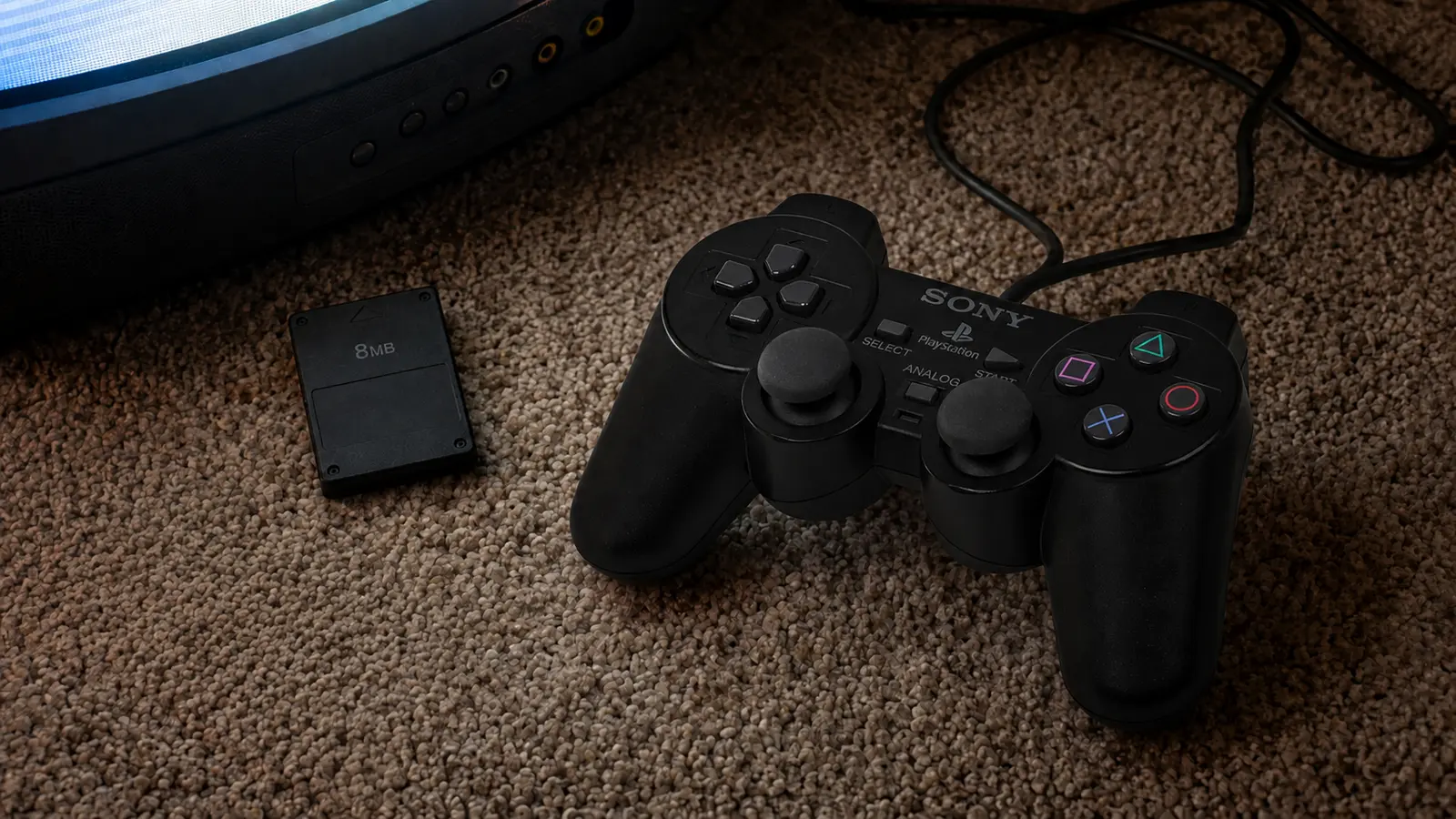
The DVD drive helped the console become part of the living room, but a machine needs reasons to remain there. In 2001, those reasons arrived in sharply different forms. Remembering the year means remembering both the new possibilities and the familiar arrangement around them: a heavy television, a cable across the floor, limited memory-card space and someone waiting for a turn.