
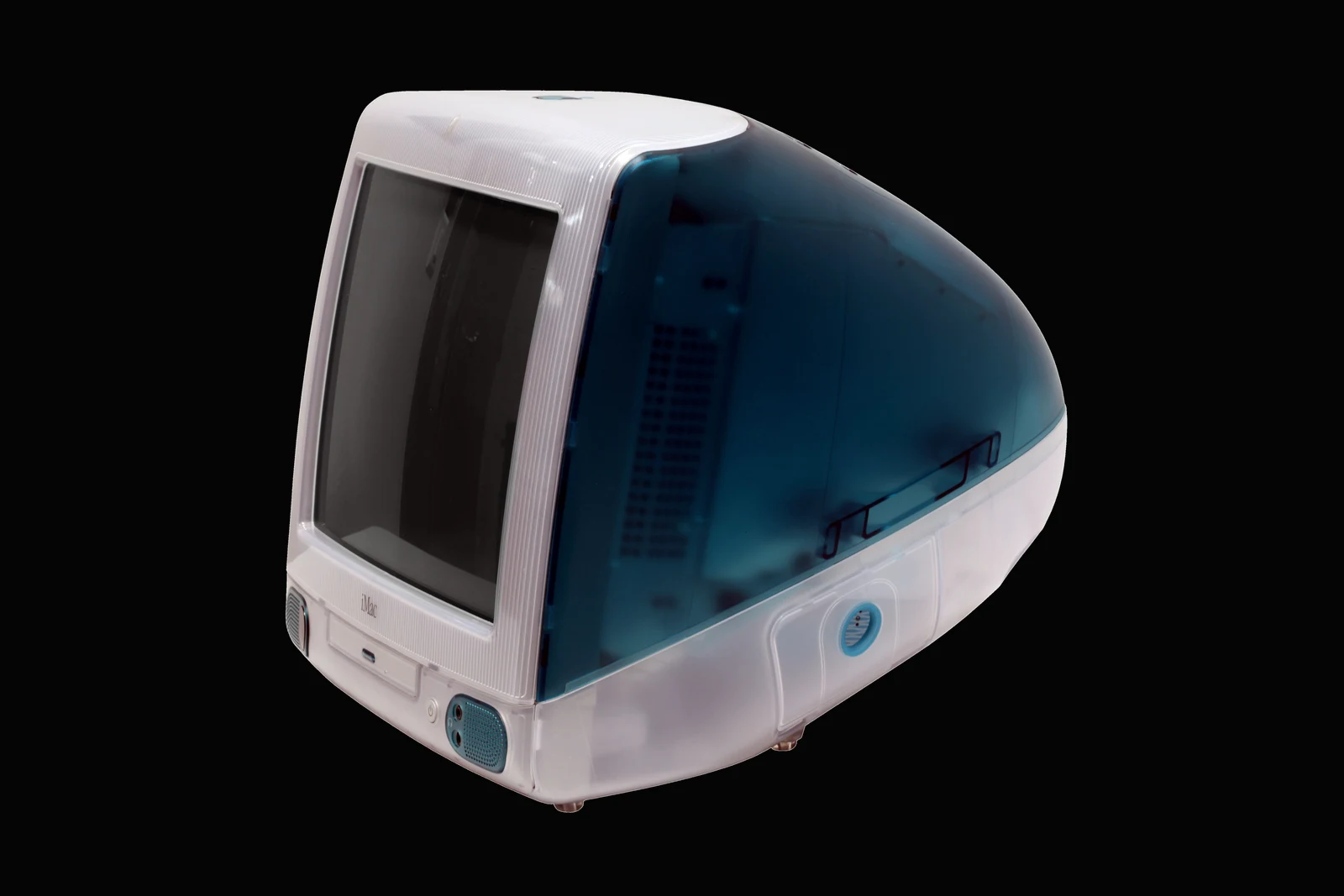
Most computers waited for the screen to light up before showing you anything interesting. The iMac G3 made its first argument while switched off: curved shell, translucent color, a whole computer that looked like somebody had actually considered the room around it.
You might find it friendly, strange or too conspicuous. It was certainly harder to overlook than another conventional desktop box. Choosing this computer also meant choosing a visible object to share the house with.
A shape you could recognize across the room
The screen and computer occupied one rounded enclosure. The translucent areas let you see suggestions of the structure beneath the surface without turning the machine into a fully exposed technical diagram.
That halfway visibility is important. Clear plastic can imply openness, but a glimpse of internal shapes does not explain what every component does. The attraction is visual as much as educational: depth, color, and the sense that there is something interesting inside.
The photograph shows a Bondi blue iMac G3. Later machines expanded the color palette, but it is easy to blur several years of hardware into one remembered object. A blue translucent shell does not by itself establish that every specification belongs to the first model.
The internet was part of the pitch
Apple’s May 6, 1998 announcement framed the iMac around the internet and Macintosh simplicity. It listed built-in Ethernet, USB connections, stereo speakers, and a CD-ROM drive among its features.
That combination gave the design a practical context. The machine was meant to be understood as a ready place to begin, rather than a set of components a household had to assemble into an identity.
The shell could not remove every difficulty of owning a computer. Software, connections, compatibility, and setup still mattered. But it could make the initial encounter less visually forbidding. A family desk acquired an object with a character before anyone opened a program.
Color became a choice about the room
Apple’s 1999 slot-loading iMac specifications list Strawberry, Blueberry, Grape, Lime, and Tangerine. Those names describe an aesthetic far more readily than a processor speed does.
That does not mean the specifications became irrelevant. It means the purchasing conversation had another entry point. Two people could disagree about which one they wanted without either having to argue about memory or storage first.
For a device likely to remain in a shared room, appearance was a real feature. You would see the computer when it was idle as well as when you were using it. Its side and back might be visible from the doorway. The design acknowledged that a desktop computer was also a household object.
Check the ports before falling in love
The same integrated shape that made an iMac visually coherent also made its parts feel like a single commitment. You were choosing the screen and the computer together. Its substantial CRT body was very different from the thin displays that later became normal.
Connections also deserve historical precision. The 1999 specifications distinguish particular configurations and identify features such as FireWire on the DV and Special Edition models. It would be inaccurate to assign every later option to the original 1998 machine.
This is where design nostalgia is most interesting when it stays honest. An appealing shell does not make old hardware frictionless. It can make the friction more memorable because it belongs to an object with such a strong identity.
Why translucent technology still looks like a moment
Translucent plastic combines two signals that usually pull in different directions. It suggests something futuristic by revealing hidden structure, and something toy-like through saturated color and softened surfaces.
The iMac G3 makes that combination especially visible because of its size. A translucent accessory can be a small accent. This machine brought the look to the main object on the desk, where it could set the tone for everything around it.
Its appeal is not only a wish to use an old operating system again. It can be a wish for technology to have a more obvious personality: a color chosen because you liked it, a shape that made you curious, a product you could describe without reading its model number.
The iMac G3’s strongest visual trick was making the computer seem approachable without hiding that it was a machine. You could see just enough through the shell to wonder about the rest.
Keep exploring
- Windows XP: How an Operating System Became a 2000s Icon
- 7 Technologies From 2001 That Helped Build Our Digital Lives
Hero photograph: IMac G3 Bondi Blue, three-quarters view.png by Alterations by David Fuchs ; original by Rama , licensed CC-by-SA. CC BY-SA 4.0. Resized and padded for this page; photograph otherwise unchanged.


