PRESS PLAY / THE NOSTALGIA FILES
A curb could interrupt a perfectly good chorus. With a portable CD player, you sometimes learned to walk for the benefit of the song: steady steps, careful landings, no sudden victory dance. Anti-skip was the machine’s attempt to give the music a little breathing room.
Anti-skip systems could read audio ahead into memory, then play from that reserve while the optical pickup recovered from an interruption. The reserve bought time. It did not make the disc, pickup or recording immune to every movement and defect.
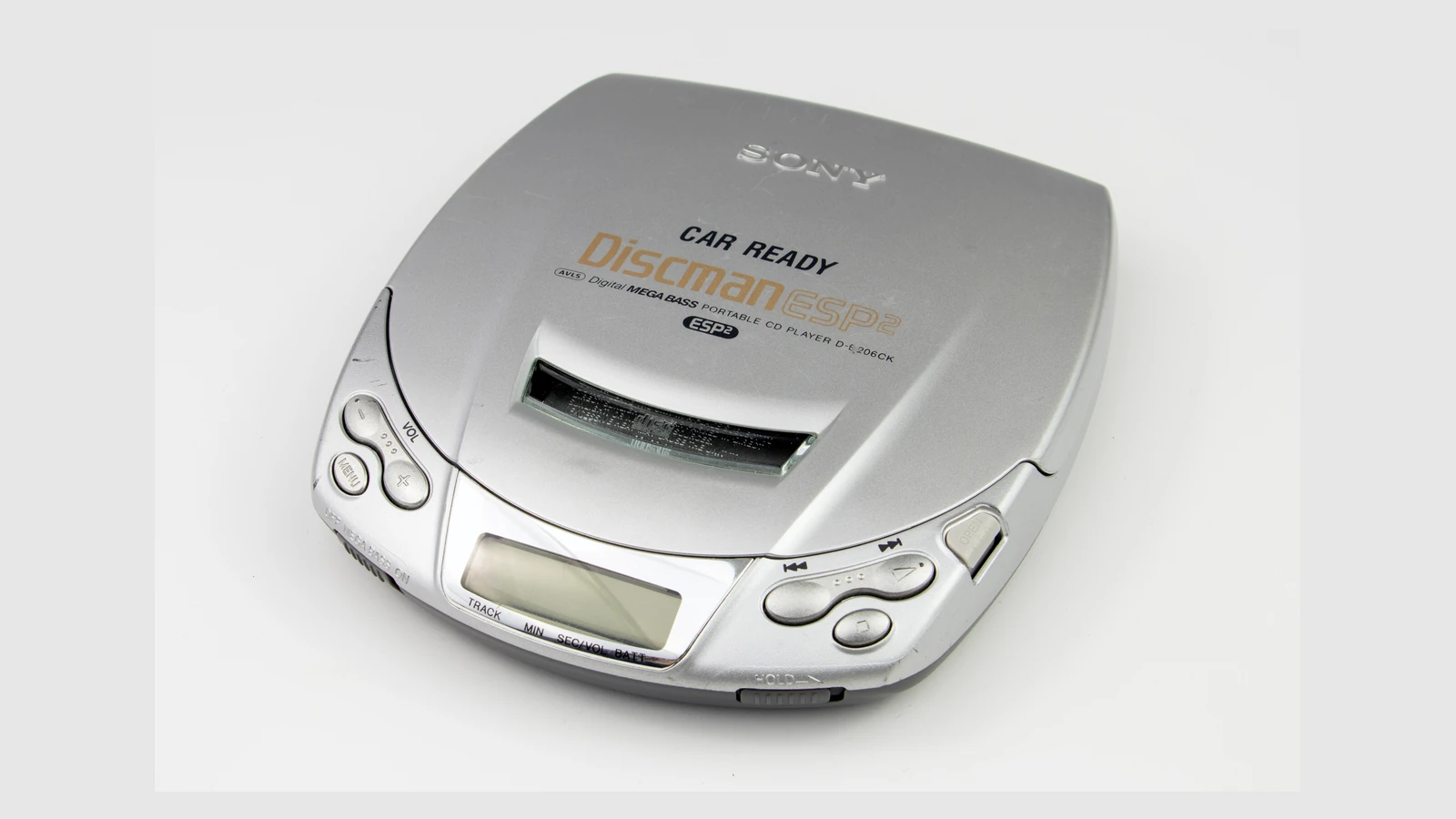
The exact system depended on the player. Electronic Shock Protection, Super ESP and G-PROTECTION should not be collapsed into one universal specification shared by every Discman and CD Walkman.
Give the next chorus somewhere to wait
Can the music survive a bump?
Bump the player. Can its saved music cover the gap?
Silent demo. Watch what happens.
Try it without anti-skip
How it works
A player can read audio ahead into memory. If the optical pickup temporarily loses a usable read, playback continues from stored data. If the interruption lasts longer than the reserve, the music can break. Mechanical protection, tracking recovery and buffering can work together; no buffer is unlimited.
The six blocks are invented teaching units, not seconds or real-player specifications. Repeated bumps use up the reserve. “Let it recover” represents an uninterrupted opportunity to refill it. Real ESP and G-PROTECTION systems differ by model.
Choose “Bump the player” with anti-skip protection on. The saved music covers the interruption. Repeated bumps empty the reserve; “Let it recover” refills it. Turn protection off and try a bump again. The display shows when the music would skip. This is a silent demonstration.
The six units are invented for teaching; they are not seconds or a measurement from a Sony model. No sound is playing. The point is the separation between reading the disc now and hearing audio that was read a little earlier.
Digital sound still needed a physical read
A disc contains encoded information that an optical system must follow and interpret. Keeping that process usable inside a portable device is different from reading a player sitting quietly on a shelf. A bump can disrupt a usable read, and the system needs time to regain it.
Mechanical suspension, tracking control, error handling and stored data can contribute at different stages. Calling the entire problem “the laser jumped” is memorable shorthand, but it does not identify which stage failed in an individual player.
Our diagram intentionally does not attempt that diagnosis. It begins with an interruption and asks what a read-ahead reserve can do about it. That narrower question is both easier to see and more honest than pretending to simulate a complete optical mechanism.
Memory separates two clocks
One process fills the reserve with successfully read audio; another consumes it for playback. Those processes do not have to proceed in perfect lockstep. When the pickup briefly cannot supply new data, already stored material can continue feeding the sound output.
Sony’s original D-777 documentation describes Super ESP using buffer memory. It is a concrete manufacturer example of the principle, not evidence that every portable CD player had the same reserve duration or recovery behavior.
A real player manages reading and playback continuously. “Let it recover” compresses that uninterrupted reading period into one deliberate action.
Why protection could still lose
If useful reads stop for longer than the stored reserve can cover, the separation between reading and listening no longer hides the problem. Repeated interruptions can also prevent the player from rebuilding its cushion. A promise of protection is not a promise of unlimited silence-free operation.
The Sony D-NE9 manual, for example, gives model-specific G-PROTECTION settings and warns about circumstances where sound can still skip. Its instructions distinguish behavior according to use and media. That is why the exact model manual matters more than a generic anti-skip badge.
A dirty, damaged or badly recorded disc creates another reason to avoid an instant diagnosis. If playback fails at the same passage while the player sits still, motion is not the only variable left to examine.
Did anti-skip always change the sound?
Do not infer an audio-quality tradeoff solely from the existence of memory. Different players and protection modes can use different processing arrangements. A careful comparison requires the exact model, mode, source disc and output path rather than a rule that every anti-skip system necessarily sounds worse.
The D-NE9 manual is useful here because it offers specific operating guidance rather than a universal claim about portable players. We have not made hardware recordings or conducted a listening test for this article. The silent model explains stored time; it cannot establish sound quality.
Read the little model number
If you are returning to a portable CD player, identify the full model and find its instructions. Check supported disc formats, protection settings, battery guidance and maintenance instructions. “Discman” alone covers too much hardware history to answer those questions reliably.
Try alternating “Bump the player” and “Let it recover,” then try several bumps in a row. The music itself has not changed. What matters is whether the player has saved music ready to fill the gap.
That is the elegant part of anti-skip. It did not have to stop the world from jostling your player. It could make a short disruption arrive late enough that your headphones never needed to reveal it.
Sources and further reading
- Sony D-777 original service documentation, hosted by ManualsLib — manufacturer description of Super ESP buffer memory
- Sony D-NE9 operating instructions — model-specific G-PROTECTION operation and limitations
- Sony D-777 manual index — official route to the model’s user documentation
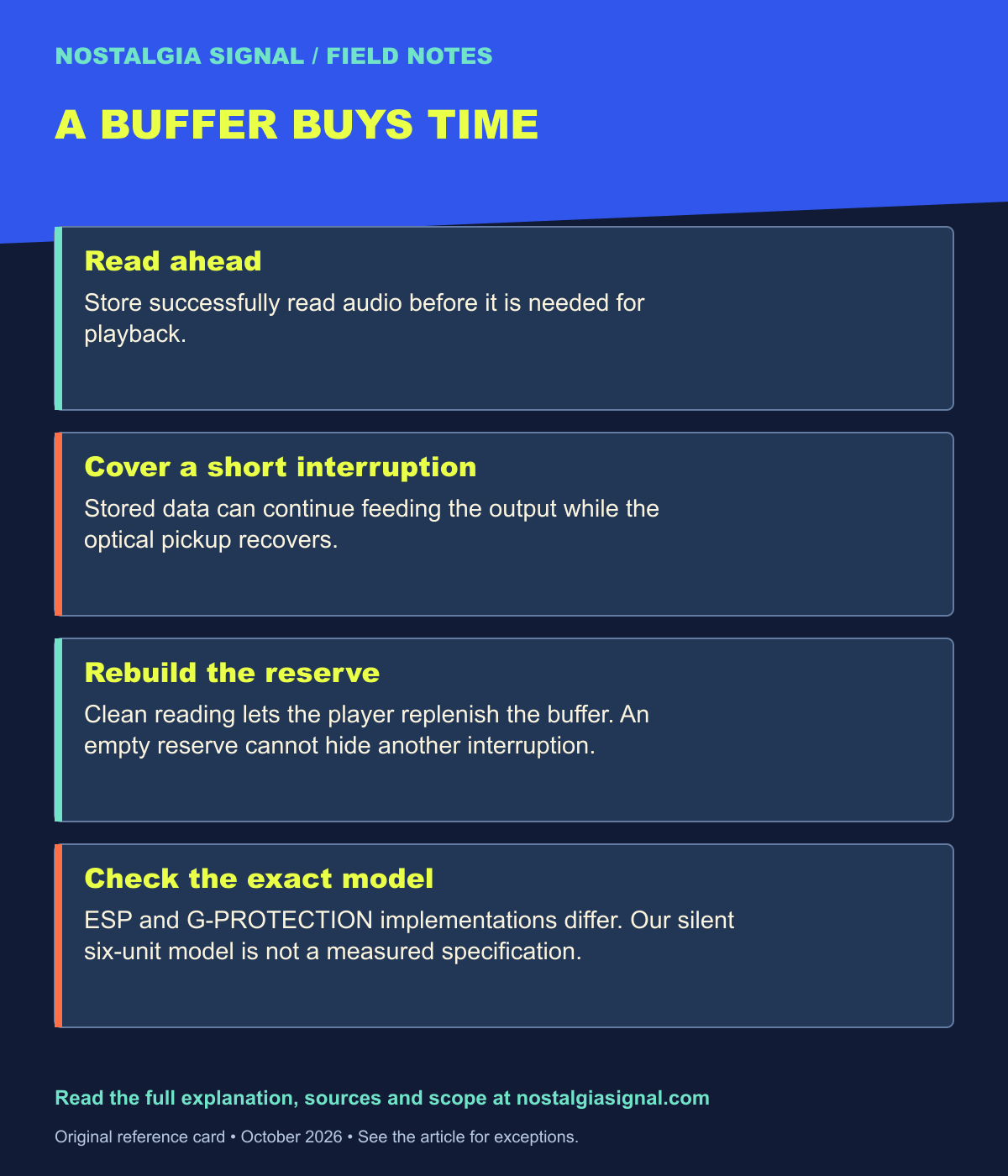
Keep the field notes
A handy reference for the next time this question comes up.
Open the full-size card ↗Save the PNG ↓
Follow the signal
- The CD Comeback: Why Streaming-Era Listeners Are Buying Discs — Why listeners are choosing the disc again.
- The iPod Comeback: Why a Music Player With One Job Still Matters — The later music player that removed the spinning disc.
- 7 Essential Albums From 2001: A Year That Sounded Like the Future — Choose an album from the portable-CD era.