INSIDE THE MACHINE / THE NOSTALGIA FILES
The orange gun looked like the active part of the arrangement. You pointed, squeezed the trigger and expected something to travel toward the television. The surprising part is that the information traveled the other way: light from the screen reached a sensor inside the gun.
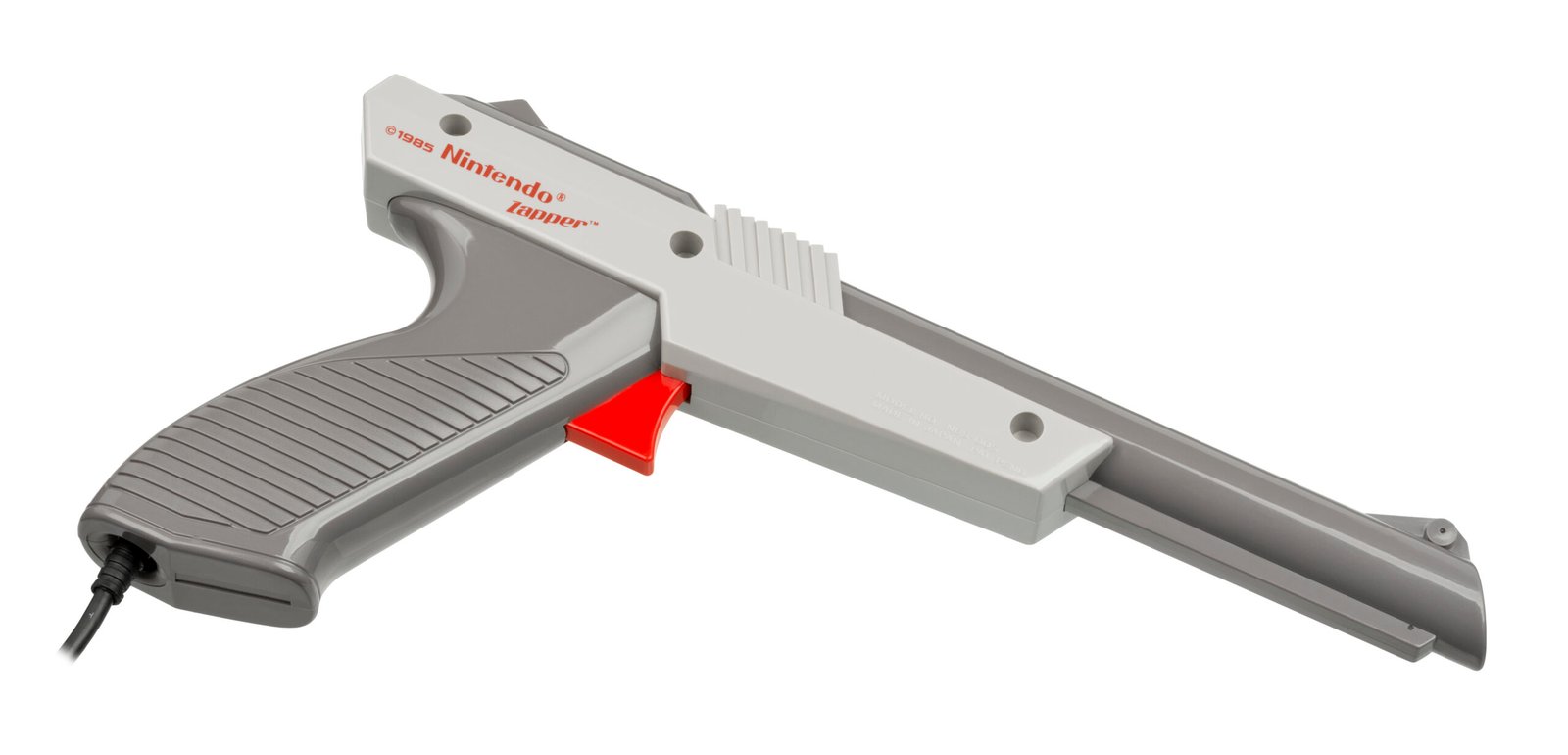
Duck Hunt’s Zapper works with the game and display: the game detects the trigger, briefly changes what the screen shows, and checks the gun’s light-sensor signal during its target test. It does not send a laser to the duck or continuously report a modern cursor position.
That makes the television part of the control system. It is not merely showing the result after the console has already decided everything.
Slow the hidden sequence down
The gun was watching.
Did the gun send a beam? No—it looked for light. Press “Pull the trigger” and uncover the trick, one step at a time.
Pull the trigger.
The game notices the trigger input. In this slow teaching sequence, your crosshair shows where you are aiming.
Slow, simplified teaching diagram using original artwork; no hardware test or game emulation. Research: Nintendo’s light-gun patent.
How it works: all four steps
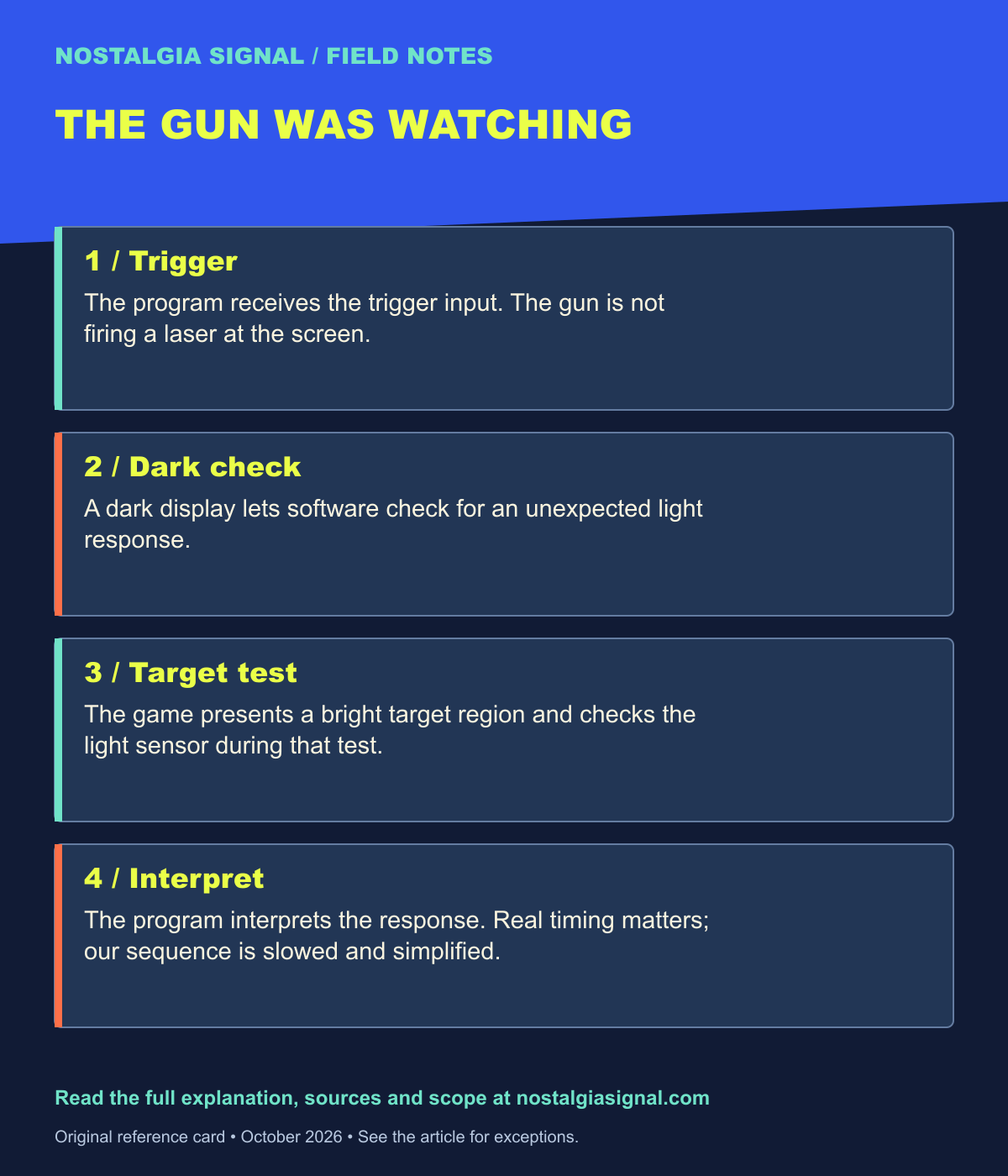
- Trigger: the game receives an input from the gun.
- Dark check: a dark frame lets the game check for an unexpected light signal before the target test.
- Target test: the game displays a bright target region and reads the light sensor during that test.
- Result: the game interprets the sensor response and records a hit or miss. Multiple targets can require separate tests.
Press “Pull the trigger” to begin, then use the changing next-step button to move through the dark check, bright target test and result. Choose “Away from it” and reset to compare a miss. Each step waits for you; nothing flashes automatically.
The crosshair is an explanatory overlay we added. It is not information the real gun supplies to the NES. Likewise, our stationary illustrations and paused steps are not a timing-accurate emulation. They expose the logic while avoiding rapid flashing on this page.
THE FIELD NOTES / TRY THIS
Check the shipped-game example separately
What a player sees
The National Videogame Museum’s Duck Hunt exhibit describes the screen briefly going dark and the duck becoming a white square. That is game-specific context alongside the broader Nintendo patent.
What this page slows down
Our four stages expose that detection idea. They do not claim exact frame counts, reproduce a multi-duck routine in full, or give the real gun a crosshair coordinate.
Why go dark before testing the target?
A light sensor can report light without knowing what produced it. A bright-room condition is not automatically evidence of a duck. A preliminary dark test gives the program a way to reject an unexpected light response before presenting the target test.
Nintendo’s light-gun patent describes the broader approach of checking sensor response while changing displayed regions. The clever idea is controlled presentation: the program knows when and where it asked the screen to become bright, and interprets the response in that context.
Our diagram condenses that idea into four readable steps. Do not read its button presses as actual frame durations. In a running game, the relevant display changes and sensor checks happen far faster than a reader manually advancing this page.
The white block is a question
When the target region becomes bright, the program is effectively asking whether light from that region reaches the gun. Aim at the target and the simplified diagram returns a hit; aim outside it and the target response is absent.
With more than one target, checking regions separately lets software associate a response with a particular test. This is very different from measuring a freely moving pointing coordinate and comparing it with a rectangle afterward.
The distinction explains why “the gun knows where I aimed” is a convenient description, but an incomplete technical one. The whole system establishes a result through a sequence of known conditions. The gun alone is not reconstructing the scene.
Why an ordinary modern television can break the trick
The original arrangement depends on the timing and light characteristics of the expected display. Modern processing can introduce delays between the console’s output and the visible image. Display behavior also differs from the CRT environment the accessory was designed around.
The NESdev Zapper reference, based on hardware investigation, discusses the sensor and timing requirements. This is why a cable adapter that produces a visible picture does not automatically produce a working light-gun system. Video compatibility and input compatibility are separate checks.
Avoid the opposite overstatement too: modified software, replacement light guns and specialized modern-display solutions can change the arrangement. “My original gun and original game do not work through this setup” is a narrower and more useful statement than “no light gun can ever work on an LCD.”
Was the famous lamp trick real?
The tempting shortcut is to reason that a light sensor must accept any bright lamp as a hit. That ignores the program’s dark checks, the sensor’s response characteristics and the timing of the test. Brightness by itself is not the entire protocol.
There is no need to point the accessory at a dangerous light source to explore the idea. The manual diagram already reveals the key distinction: an unexpected signal during the dark step is different from an expected signal during the target step.
For an actual setup, identify the gun, game, console and display chain before troubleshooting. An original accessory, a clone and a modern adaptation need not have identical behavior. Our feature explains the original principle; it is not a compatibility certificate for every product using the Zapper name.
The television was doing part of the thinking
The satisfying discovery is how little information the gun needed to contribute. A trigger and a light response became useful because the software arranged a question the hardware could answer. The screen briefly stopped being scenery and became a test pattern.
Once you recognize that partnership, the flash is no longer a random visual interruption. It is the hidden conversation that makes the shot possible.
Sources and further reading
- Nintendo patent US4813682A — original light-gun system description
- NESdev: Zapper — hardware research on light response and timing
Keep the field notes
A handy reference for the next time this question comes up.
Open the full-size card ↗Save the PNG ↓
Follow the signal
- Castlevania at 40: The Castle That Reinvented Itself — Another look at NES-era design.
- Nintendo 64: The Console That Took Nintendo Into 3D — Follow the next generation of controller ideas.
- Pokémon at 30: How a 1996 Game Became a Worldwide Obsession — Explore a different clever hardware connection.
The Zapper was one way the TV and console worked together. Our guide to why retro games look different on a CRT explains what the screen did for the picture itself. On the console side, here’s what happens inside the NES when you press Power and why NES sprites flicker when too many sprites share a line.