
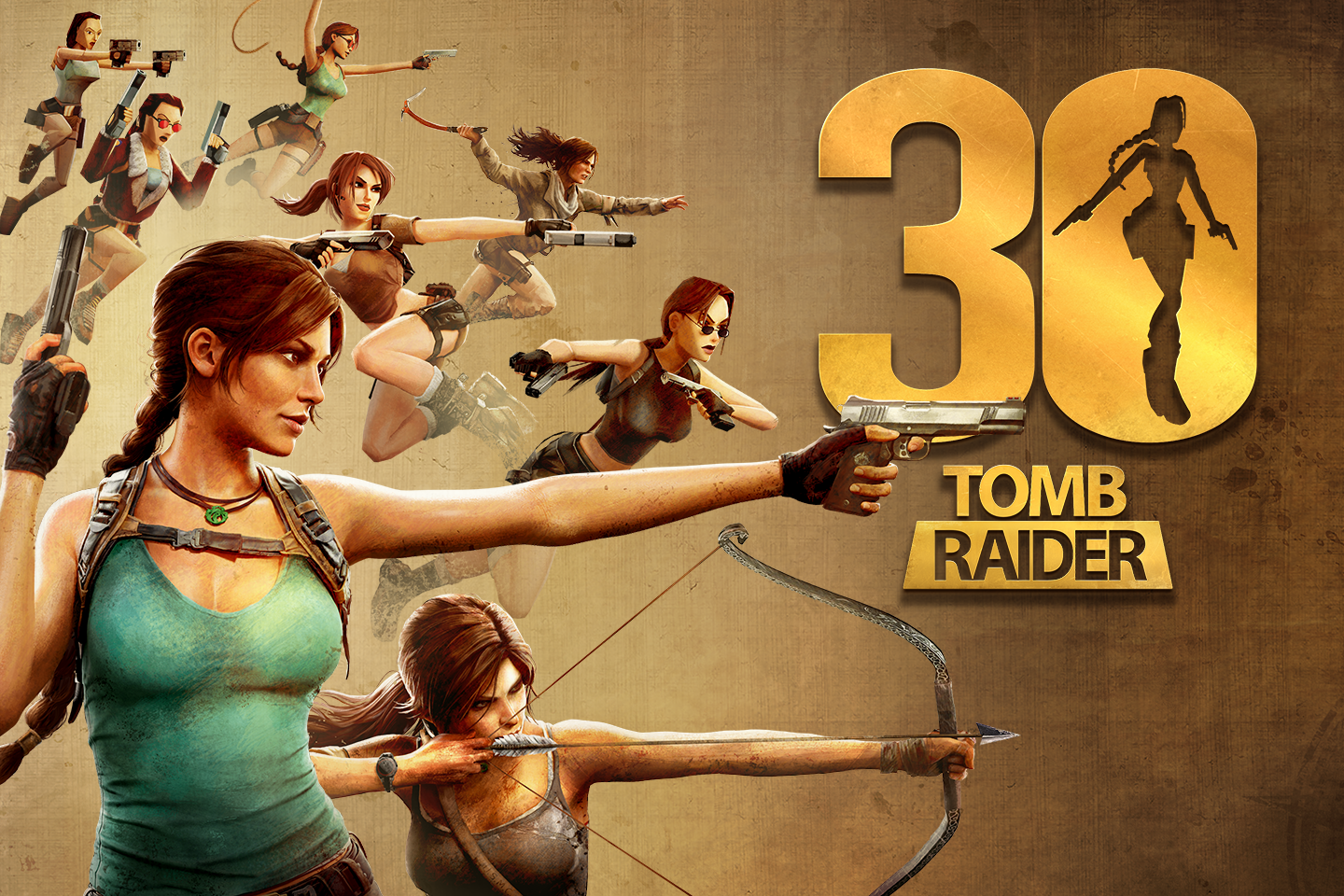
Walk to the edge. Take a step back. Run, jump, reach—and hope your hands find stone before the floor becomes a very distant problem.
The original Tomb Raider made movement feel earned. Its rooms were not just scenery for a fight; they were puzzles that had to be understood through Lara Croft’s body. A ledge on the other side of a cavern was a question, and a successful landing was your answer.
Thirty years after the 1996 game, that mixture of precision, solitude and discovery still explains more about Lara’s appeal than the polygons that made her famous.
1996 was a year of learning how to move
Game developers were working out the grammar of three-dimensional worlds. Super Mario 64 made running and jumping feel elastic. Resident Evil made crossing a room feel dangerous. Core Design’s Tomb Raider found its own rhythm in measured steps, climbs and leaps.
The original reached Sega Saturn, PlayStation and PC. It sent Lara through caves, ruins and increasingly strange places in pursuit of the Scion, an artifact whose fragments gave the journey a reason to keep opening new doors.
Its official series history identifies the Core Design games as the classic era. Within that history, the first adventure has an unusually clear identity: one capable explorer, an enormous space and very little reassurance.

The controls asked for a little geometry
Classic tank controls moved Lara relative to the direction she faced. You lined her up, judged the distance and committed. The underlying grid made that process more consistent than it might first appear, even when the camera was being less than helpful.
It could also be unforgiving. Turning too late or rushing a setup could turn a straightforward jump into a long fall. Learning the system meant accepting that Lara was not going to correct every mistake for you.
There was satisfaction in that bargain. A route which initially looked impossible could become repeatable once you understood the spacing. You were building a vocabulary of running jumps, standing jumps, grabs and careful walks.
The official guide to the classic games describes the emphasis on exploration and precise movement. It is a useful reminder that older controls can be unfamiliar without being arbitrary.
The room itself gave you the problem
A huge chamber might reveal several doors, a pool, a switch and a high platform that seemed unrelated to everything else. Understanding their relationship was the level.
The absence of constant instruction gave the architecture weight. You looked up because there might be a route above you. You remembered a locked door because a newly discovered key could finally explain it.
Backtracking was not always elegant. Getting lost could be tedious. But the moments of recognition belonged to the player: that ledge connects to the balcony; that switch opened the gate; that strange object finally has somewhere to go.
Tomb Raider’s quiet stretches made those discoveries feel private. The game did not need a conversation happening over every corridor to keep the journey moving.

Croft Manor made practice feel like play
The training level offered a gentler introduction to Lara’s abilities. Without a tomb trying to kill her, you could experiment with timing and learn how much space a jump required.
It also gave the character a life beyond the immediate adventure. A home, a voice and a confident way of moving made her more specific than a figure dropped into a level.
Later games expanded that playground. The famous business of trapping Winston in a freezer belongs to Tomb Raider II, not the first game—a small distinction easily lost when thirty years of memories collapse into one enormous mansion.

Lost Valley understood the power of a surprise
The Tyrannosaurus rex encounter remains one of the first game’s defining memories. After enclosed spaces and smaller threats, the sudden scale of the dinosaur changes the meaning of the landscape.
It is not merely a bigger enemy. It tells you that the game is willing to interrupt your assumptions about what belongs in this world. The ruins can contain something stranger than another trap.
Knowing about the encounter in advance changes the surprise, but not the design lesson. Exploration works best when finding a new place can also mean discovering a new kind of danger.

Lara became famous beyond the games
The silhouette was immediately legible: braid, backpack, boots and a stance that suggested she had already decided to enter the dangerous place. Advertising and magazine covers amplified that recognizability until Lara became a celebrity as well as a game character.
Her image also carried the contradictions of the period. She was a confident woman driving a major action series, while marketing frequently emphasized her body as much as her abilities. Remembering the breakthrough does not require pretending those two things were separate.
Angelina Jolie’s 2001 film took the character to another audience. By then, Lara’s name could mean a game, a promotional image or a Hollywood adventure, depending on where someone had first encountered her.
Reinvention became part of the series
Core Design’s run extended through The Angel of Darkness in 2003. Crystal Dynamics later reshaped the series with Legend in 2006, followed by Anniversary and Underworld.
The 2013 Tomb Raider introduced a younger Lara in a harsher survival story. Rise of the Tomb Raider and Shadow of the Tomb Raider continued that version’s journey. The action became more cinematic, but the character’s relationship with dangerous places remained central.
The remastered classic collections offer another route back. They preserve the old adventures while providing presentation and control options that make revisiting them more approachable. A remaster and a reimagining do different jobs: one helps you return to an existing design; the other rebuilds the premise.
The anniversary points back toward the first expedition
Crystal Dynamics began its thirtieth-anniversary celebrations in 2026. The next return to the original adventure is Tomb Raider: Legacy of Atlantis.
As of October 2026, the publisher’s September announcement gives the reimagining a February 12, 2027 release date and confirms a Nintendo Switch 2 version. It is an upcoming game, so promises about its design should not be confused with a verdict on the finished experience.
What makes that return interesting is the question beneath the new technology: can a familiar place still make you curious about what lies beyond the next opening?
The original answered that question with remarkably simple ingredients. A dark entrance. A ledge overhead. Lara looking toward it. And the player deciding to take one more step.


Shared memories