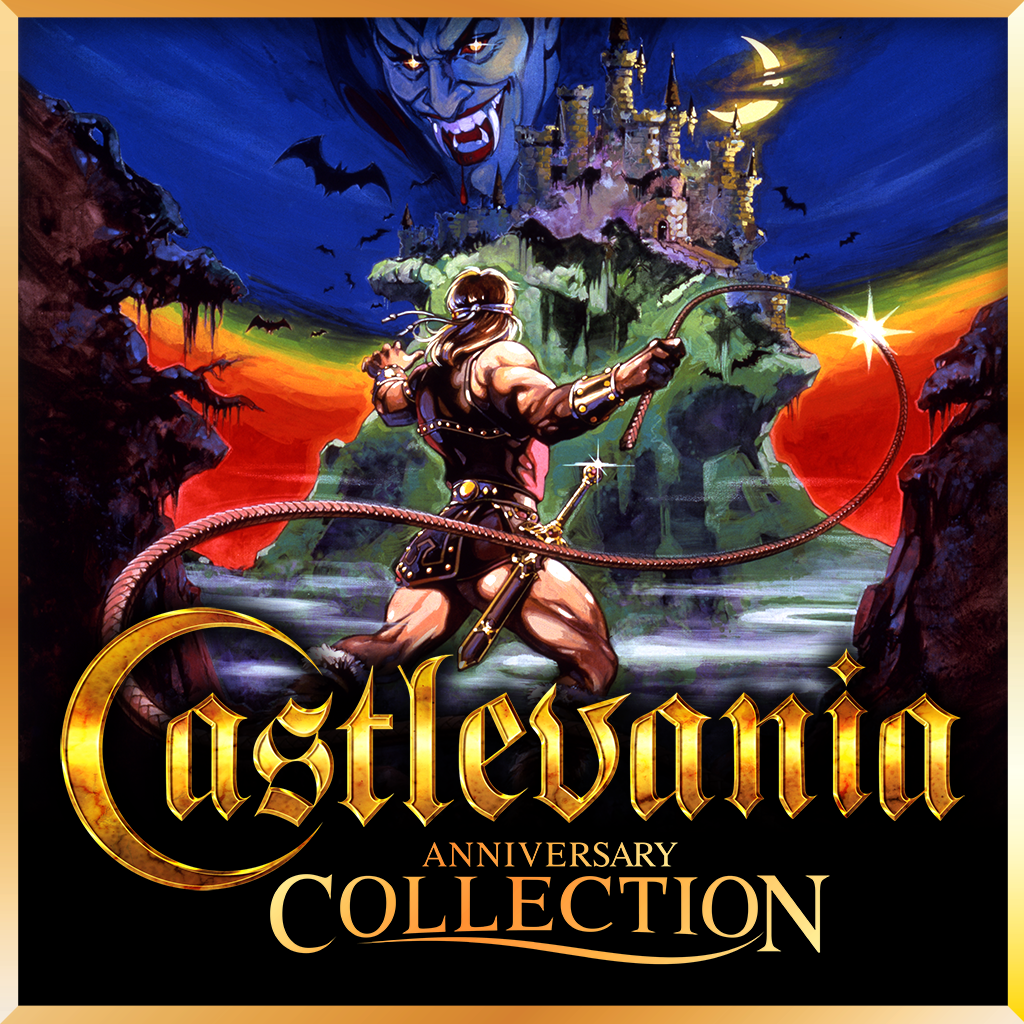
A staircase. A gap. A Medusa Head arriving at exactly the wrong moment. For anyone who met Castlevania on an old television, those three things may be enough to bring an entire room back.
The series turns 40 in 2026, with another game on the horizon. Konami lists Castlevania: Belmont’s Curse for October 15, 2026. Its description as a 2D action-exploration game is a useful reminder of how much ground that castle has covered since 1986.
Castlevania first made forward movement a test of timing. Later, it made the entire building a puzzle you could carry around in your head. The series’ history becomes much clearer when you look at those two changes together.
1986: every step had a weight
Akumajō Dracula debuted in Japan on September 26, 1986, for the Famicom Disk System. The NES version followed in North America in 1987, as Konami’s U.S. history page records. The familiar gray cartridge was not the game’s original format.
Simon Belmont moved with a deliberate stiffness. His whip needed time to unfurl. His jump followed a committed arc. A hit could knock him backward into a pit, turning a seemingly ordinary encounter into the end of a run. You could not improvise your way out of every mistake.
Those constraints made distance matter. A skeleton on the other side of a gap was a problem to solve before jumping. A flying enemy near a staircase could require more attention than a much larger monster on level ground. The player had to read what was about to happen and act early enough to meet it.

You learned the castle like a difficult song
Progress came in repetitions. You reached a little farther, lost a life, and returned knowing where to wait or when to attack. The satisfaction was not limited to seeing a new screen. It was noticing that your hands could now handle a sequence that had seemed impossible ten minutes earlier.
That gave the people watching something to do as well. Someone could warn you about the next enemy or insist they knew the timing. A borrowed or rented cartridge made the whole exercise more urgent: the weekend was disappearing, and Dracula was still several humiliating mistakes away.
The game also had an unusually strong sense of place. Towers, stained glass, candles and monsters borrowed from classic horror appeared alongside music that made the little console sound far more theatrical than it looked. You did not need to know the backstory to understand that you had entered somewhere forbidden.
A candle could contain hearts for a secondary weapon. A suspicious wall might hide food. The architecture was dangerous, but it was also full of promises. That mixture of threat and curiosity would prove extremely useful to the series later.
The family could outlast any one hero
Castlevania did not remain tied to a single Belmont. Trevor, Simon, Richter and other members of the family let the games move through different periods and styles while preserving a recognizable responsibility. Someone would inherit the weapon and face the darkness again.
That structure gave new players several possible entrances. One person’s Castlevania was an exacting NES obstacle course. Another’s was a richly animated adventure with alternate routes. The continuing family story connected them without requiring every installment to behave in exactly the same way.
The most effective continuity was physical: a familiar weapon, an imposing entrance, a staircase pointing toward a confrontation. Even when the details changed, you knew what kind of threshold you were crossing.
1997: the castle became the adventure
Symphony of the Night changed the relationship between the player and the building. Playing as Alucard, you explored a connected space filled with equipment, abilities, secrets and routes you could see before you knew how to reach them.
A new power did more than improve your chances in a fight. It changed your understanding of a room you had already visited. The ledge that had annoyed you an hour earlier became an invitation. Returning somewhere familiar could produce discovery instead of repetition.
Experience levels and equipment also gave difficult encounters more than one possible answer. You might learn an enemy’s timing, find a better weapon, experiment with a spell or explore another part of the map. Precision still mattered, but curiosity now had much more room beside it.
This was not Castlevania’s first experiment with a less linear structure. Simon’s Quest had already mixed traversal, towns and role-playing ideas, while Rondo of Blood offered alternate paths. Symphony brought exploration and progression together with a coherence that made the map feel like the central mystery.

Two dimensions still had secrets left
The timing made Symphony particularly distinctive. The industry was fascinated by polygonal worlds. Tomb Raider was turning three-dimensional space into a physical puzzle, and Nintendo 64 made freedom of movement part of its appeal.
Castlevania offered another route forward. Its animation, architecture, sound and dense network of rooms gave 2D an atmosphere that did not need to apologize for being flat. A hallway could contain more interest than a larger environment if you had reasons to look closely at it.
The change also rewarded a different kind of memory. In the earlier games, remembering meant knowing the next enemy. In Symphony, it could mean remembering a blocked passage on the other side of the castle and realizing that you had just acquired its solution.
The handheld years made the map a companion
Game Boy Advance and Nintendo DS proved especially comfortable homes for that style of adventure. You could explore a few rooms, find an item and return later with one more small piece of the castle understood. The family television no longer controlled when you were allowed to play.
Different games introduced different systems: souls to collect, portraits to enter, companions to coordinate and equipment to reconsider. Underneath those variations was the familiar tug of an unfinished map. A visible gap could be enough to bring you back for another session.
Short play sessions did not have to feel trivial. A newly opened connection between two areas could be a satisfying result in itself. The castle became somewhere you lived alongside for a while, rather than a sequence you simply cleared.

Its influence kept moving during the quiet years
Castlevania’s history includes experiments in three dimensions, major changes of approach and long waits between new games in the classic style. Reissues and collections helped keep earlier entries available, while recommendations passed from one generation of players to the next.
Its design ideas also traveled beyond the name. Interconnected maps, abilities that unlock routes and the pleasure of revisiting a known area became familiar ingredients in a much wider field of games. The term “metroidvania” reflects the paired influence of Metroid and Castlevania, even though individual games under that label can feel very different.
That is a substantial legacy for a series whose original hero could make one awkward jump feel like the most difficult task in the world. The demanding movement and the inviting map turned out to be two powerful ways of making players pay attention.
Another entrance, the same invitation
Belmont’s Curse brings the family back to 2D action and exploration. Before release, that description tells us the intended direction; it does not tell us whether every new idea will work. The interesting question is how the game will balance the commitment of an attack with the temptation to leave the obvious route.
The series has two rich traditions to draw on. One asks you to master the next few seconds. The other asks you to remember a room from two hours ago. A good Castlevania can make either question feel urgent.

Forty years on, the castle remains recognizable because it has been allowed to change. The whip, the music and the monsters provide continuity. The rooms provide the uncertainty. We remember the hidden wall and the failed jump, then enter anyway, hoping there is still another door we have not found.