
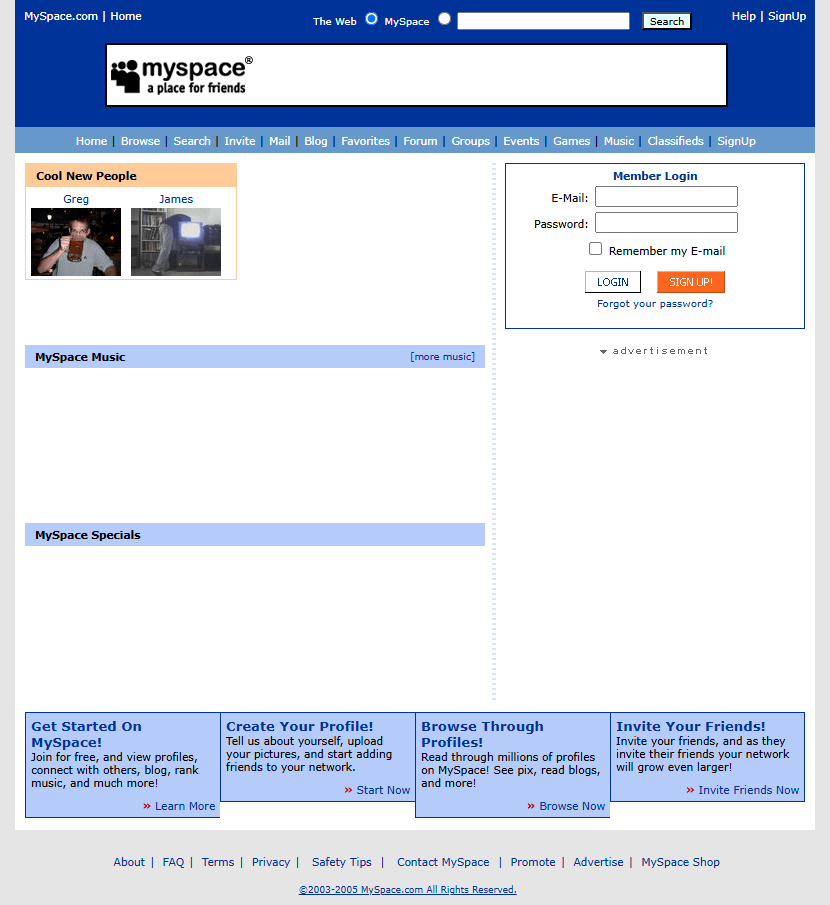
Before a social profile became a familiar arrangement of boxes, it could be a minor assault on the senses. A song started without asking. Glitter moved behind the text. A photograph loaded at the wrong size. Somewhere in the chaos, eight friends occupied a very public ranking.
MySpace gave people a place to present themselves with unusually visible choices. The result was often awkward, sometimes beautiful and immediately recognizable as somebody’s work. Visiting a profile felt a little like being invited into a bedroom, including the possibility that you disliked the music.
The service lost its position at the center of social life as Facebook grew and friends moved elsewhere. Yet the idea of a personal corner of the web has proved more durable than any particular layout.
A profile was something you decorated
MySpace emerged in 2003 from the company then known as eUniverse, later Intermix. Tom Anderson and Chris DeWolfe became its best-known public figures, with Anderson’s profile appearing as a new user’s first friend.
The site combined social connections with elements of a personal homepage. You could write about yourself, share photographs, leave comments and shape the appearance of the page through HTML and CSS customizations.
Not every user understood the code they pasted into a box. That was part of the appeal: a small borrowed fragment could produce a dramatic change. Sometimes it also made the text unreadable or pushed an important section somewhere unexpected.
The freedom produced an informal design education. People learned through copying, breaking things, asking friends and trying again. The profile was a finished introduction and an ongoing project at the same time.
Top 8 made friendship visible in an uncomfortable way
The featured-friends grid turned a design choice into a social decision. Including somebody could communicate affection. Moving them could invite a conversation you had not intended to start.
The result was a distinctly teenage kind of interface drama. A list of names became evidence of loyalty, popularity or an argument. The feature did not invent those anxieties, but it gave them a conspicuous place on the page.
Tom’s default friendship supplied an unexpectedly useful constant. His familiar photograph became a shared joke across profiles that otherwise had little in common.
That mix of identity and social signaling also connected MySpace to the era of MSN Messenger. A screen name, a status and a song could all communicate something their owner did not want to say directly.
The profile song did the introducing
Music made the page feel occupied. An autoplaying track could establish a mood before a visitor read a sentence. It could also make several open browser tabs compete at once.
For artists, profiles supplied a practical combination of songs, a public identity and a route to listeners. A band could point somebody to one address instead of asking them to track down a physical demo.
Discovery moved through social connections. You noticed an artist on a friend’s page, followed a connection, listened and perhaps added them yourself. A network built around people could also become a map of local scenes and tastes.
Not every friendship request represented a meaningful relationship, and promotion could become noisy. Even so, the site helped make a musician’s online presence feel accessible: a page you could visit and interact with, rather than a distant biography.
The scale became impossible to ignore
In July 2005, News Corporation announced a roughly $580 million agreement to acquire Intermix Media. MySpace was the major attraction, but the transaction included Intermix’s wider network of websites; it was not simply a standalone price tag on a profile editor.
The site’s reach continued to grow. Comscore’s historical comparison places MySpace’s U.S. monthly audience peak at 75.9 million unique visitors in December 2008.
That measurement is different from registered accounts, worldwide users or the number of people posting every day. Keeping the terms straight matters when comparing MySpace with the services that followed it.
For somebody using the site after school, the more immediate measure was simpler: how many of the people you cared about were there, and how often they responded.
Facebook made consistency a competitive advantage
MySpace’s flexibility had costs. A heavily customized page could be slow, confusing or difficult to read. Advertising and unwanted messages added their own friction.
Facebook offered a more consistent environment as it expanded. You could arrive on somebody else’s profile and already know where things were. Individual pages had less visual personality, but the overall service was easier to navigate predictably.
Worldwide audience comparisons put Facebook ahead in 2008; the U.S. crossover came later. The more important change was behavioral. People increasingly expected to find their friends and new activity on the other service.
A social network does not need to become unusable to lose somebody. If the conversation has moved, checking the old site becomes an extra task. Fewer visits produce fewer replies, giving the remaining users another reason to leave.
Redesigns and a stronger focus on entertainment could change the product, but rebuilding a habit shared by millions of people was a harder problem.
The 2011 sale marked a change of ambition
News Corporation sold MySpace to Specific Media in 2011, in a deal reported at about $35 million. Justin Timberlake was associated with the effort to develop a new creative direction.
Music was an understandable focus. It was one of the site’s strongest associations and offered a reason to visit beyond reconnecting with classmates.
But online music had become a more crowded field. Artists could use video platforms, dedicated audio services and other social networks. An old advantage now had to compete with several specialized alternatives.
The sale is often described through the enormous difference between $580 million and $35 million. That contrast captures the changed expectations, but the two transactions involved different asset packages and circumstances. Treating them as a precise percentage decline in an identical investment would oversimplify the history.
The lost music exposed the fragility of an online archive
In 2019, reports drew attention to MySpace’s admission that a server migration had left older uploaded media unavailable. Ars Technica documented the company’s explanation and the uncertainty around the loss.
For small bands, an old upload might have been the only easily accessible version of a recording. A broken player could therefore represent something more serious than a neglected account.
A separate collection preserved by the Internet Archive, the MySpace Dragon Hoard, contains hundreds of thousands of files gathered during 2008–2010. It is a partial historical collection, not a restoration of every lost song or profile.
The lesson reaches beyond one company. Uploading something makes it available through a service; it does not guarantee that the service will preserve it indefinitely. Personal photographs and recordings deserve copies outside the platform where they first found an audience.
A 2026 revival is an intention, not a finished product
In August 2026, Parade reported comments from Chris and Tim Vanderhook, made in connection with Tommy Avallone’s documentary, about plans to relaunch MySpace.
The comments renewed interest in the brand, but did not establish a confirmed launch date or a finished feature list. They should not be read as proof that the original site, music library or old accounts will return intact.
A new version would have to solve a present-day problem. Recreating an old color scheme might bring a curious visitor once. Giving people a useful reason to build and maintain a profile would determine whether they stayed.
What people miss is the permission to make something
The old MySpace could be cluttered, awkward and tiring. Remembering it fondly does not require pretending those problems were charming every time.
What distinguished it was the visible role of its users in making the place. A profile could be unfinished, unfashionable or enthusiastically overdesigned. Its owner still had a hand in how it felt.
That is why the music, glitter and badly chosen background remain so easy to recall. They were decisions somebody made about themselves. Before the next post arrived in a standardized feed, there was a page that looked like a person had spent the evening decorating it.


Shared memories