Put Timmy Turner, Zim, Samurai Jack, Penny Proud and the Justice League in the same room and the idea of a single “2001 cartoon style” falls apart. They belong to the same television year, but they ask the audience to watch in strikingly different ways.
This selection uses the year the regular series first appeared in the United States, rather than the first time every country received it. In The Fairly OddParents’ case, earlier shorts preceded the full series. Regional schedules, dubbing and reruns can make an entirely authentic childhood memory belong to a later year.
The Fairly OddParents: every solution creates another problem
Timmy’s wishes turn everyday frustration into a machine for stories. School, family and embarrassment provide the need; magic supplies the excessive answer; the consequences reveal why getting exactly what you asked for can be a disaster.
The clear premise makes the show unusually flexible. A child can understand the central relationship immediately, while each episode can change the scale of the resulting problem. Cosmo and Wanda are powerful enough to cause trouble and fallible enough to remain funny.
A contemporary Animation World Network report records Nickelodeon’s plan to launch it alongside Invader Zim in March 2001. The pairing is a useful reminder that a channel could introduce two very different creative voices together.
The show’s lasting mechanism is the fine print of desire. Wanting something is easy; imagining every consequence is harder. That problem does not depend on remembering a particular school uniform or television schedule.
Invader Zim: the world is wrong in every direction
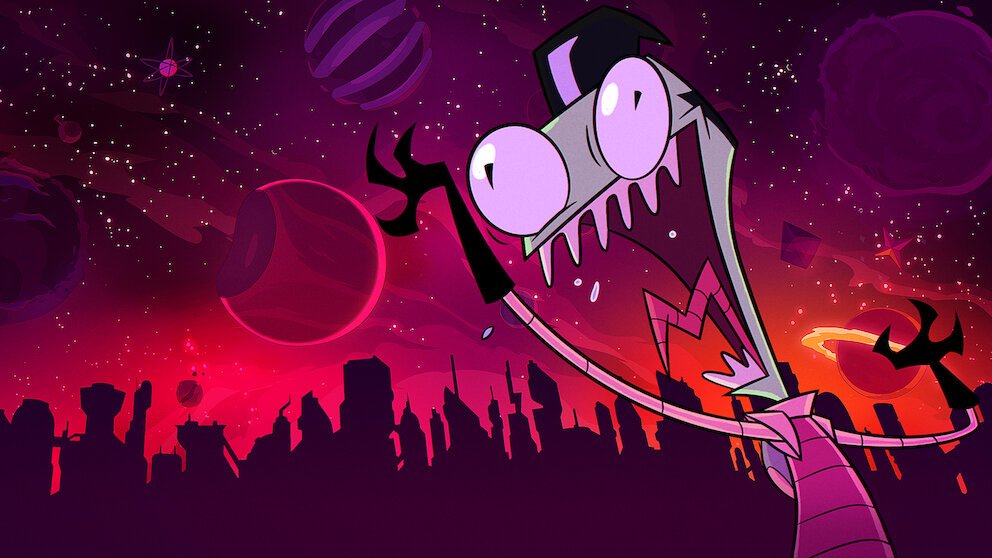
Jhonen Vasquez’s series makes school, authority and interplanetary ambition equally uncomfortable. Zim considers himself a magnificent invader, but his certainty is wildly out of proportion to his competence. Earth is not much more sensible.
The colors, sharp silhouettes and oppressive environments give the humor an abrasive physical presence. GIR can break the atmosphere with a sudden change of interest, but the surrounding world stays peculiar rather than becoming reassuring.

A shorter original run did not exhaust the characters. The 2019 film Enter the Florpus returned to the rivalry between Zim and Dib. Its existence illustrates a different kind of longevity from continuous television production: an audience can keep an eccentric world alive in the gaps.
Zim is particularly useful in this group because it resists the idea that durability always comes from broad comfort. Sometimes viewers remember a show because nothing else made them feel quite that kind of discomfort.
Samurai Jack: silence can be the spectacle
Genndy Tartakovsky’s adventure makes composition and timing carry much of the story. A landscape can establish distance and loneliness. A sound outside the frame can become a threat. A long wait gives the first sudden movement greater force.
The premise is direct: a warrior displaced into a strange future wants to return to his own time. That goal allows the individual episodes to travel through different kinds of stories without losing their center.

The show trusts viewers to look. Its quiet stretches are not empty space waiting for dialogue; they are where the world becomes readable. When a battle changes the pace, the shift feels deliberate.
Adult Swim’s 2017 event archive documents the arrival of the fifth season. The later return addressed an audience that had aged alongside its memory of Jack, giving the long unfinished journey a different emotional context.
The Proud Family: an ordinary life deserves the center
Penny Proud does not need an alien invasion to face a crisis. Friends, school and family can already make the day feel impossible. The show’s energy comes from allowing a Black family’s particular experiences to occupy the center of a broad animated comedy.
Oscar’s excesses, Trudy’s steadier perspective and Suga Mama’s independence create competing forms of authority. Penny has to grow within those relationships rather than escape into a separate magical world.
Specificity gives the humor its shape. The family need not become a solemn lesson to make representation meaningful. They can be loving, ridiculous, impatient and recognizably different from one another.

The continuation Louder and Prouder demonstrates that this world can respond to another period. Disney’s 2026 announcement set its fourth and final season for July 29 and announced a separate holiday special. Those later projects are continuations, not parts of the original 2001 premiere.
Justice League: power does not eliminate disagreement
Justice League takes heroes with distinct temperaments and asks them to function as a group. The challenge is not simply finding a threat large enough for everyone to punch. It is making their different judgments matter.
Batman’s suspicion, Superman’s responsibility, Flash’s levity and John Stewart’s discipline can push an encounter in different directions. Working together becomes a dramatic act rather than an automatic consequence of sharing the title.

The expanded world of Justice League Unlimited would build on that foundation. An ensemble becomes satisfying when the audience can remember how people have behaved before and see the consequences when their choices change.
Five shows, five ways to hold attention
The common year is less important than the range: wishes with consequences, hostile absurdity, visual patience, family specificity and collective responsibility. Animation could move among all of them without adopting one house style.
For viewers who found them through regional cable schedules, the order may have been different. A rerun could be a first encounter. That does not diminish the memory; it explains how these worlds kept finding new doors into people’s homes.