No batteries to charge. No screen to wake up. Hold a View-Master toward the light, put it to your eyes and click: two tiny photographs suddenly have depth. A cardboard reel and some very sensible optics do the traveling.
Nothing moves inside the scene, and you cannot wander around it. Yet the next click gives you somewhere else to look. Seven scenes are enough to make the little reel feel like a trip with a beginning and an ending.
Two eyes need two pictures
A standard View-Master reel holds seven pairs of images. Each eye sees one member of the pair, photographed from a slightly different viewpoint. The viewer aligns them so the difference can create an impression of depth. Williams College’s collection description explains both the paired transparencies and the lever that advances them.
That is why counting the little windows around the reel can initially be confusing. Fourteen images do not mean fourteen separate scenes. Two are working together each time you look.
There is no need for the scene itself to move to feel spatial. A foreground object can seem separate from the background, making a photograph feel more like a small arrangement you are peering into.
It was not originally just a children’s toy
The Strong’s View-Master history traces the system to William Gruber and Harold Graves of Sawyer’s Photographic Services. It debuted at the 1939 New York World’s Fair and initially presented scenic attractions. Its later connection with Disney material helped move it toward the entertainment many children remember.
That longer history explains something about the experience. View-Master can feel like a toy and a miniature tourist attraction at the same time. A reel might invite you into a fictional adventure, but the device is equally suited to asking you to look closely at a place.
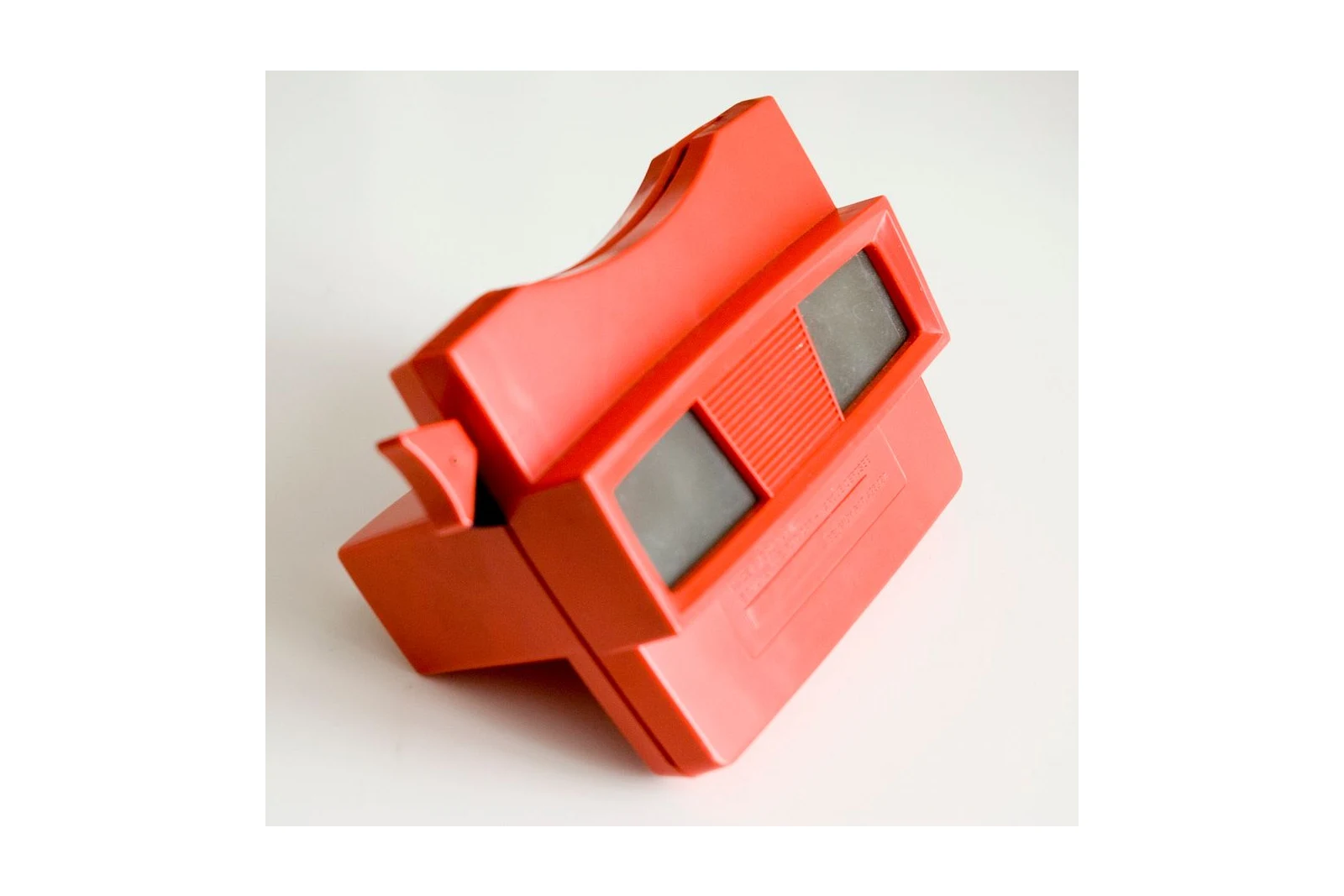
The red GAF Model G shown in the photograph is one of the classic viewer designs. View-Master appeared in different shapes across generations; the memory of a particular color or shell is not the whole history of the format.
The click was part of the storytelling
A reel does not advance until someone presses the lever. That small control gives the viewer an important role in the pace. One scene can be passed quickly; another can be examined for much longer.
With only seven positions, the sequence is easy to learn. The final image arrives with the expectation that the first is next. Repetition becomes a feature of the experience, because the return does not feel like a loading failure or an accidental loop.
It also leaves room between pictures. When a reel presents a story, the viewer must bridge the changes. A character has moved, an event has happened, or the setting is different. The mechanical gap is an invitation to supply what the static pictures cannot show.
Smallness encouraged a different kind of attention
A View-Master scene is small, but the viewer blocks out much of the surrounding room. That can make the image feel more absorbing than the reel’s dimensions suggest. The toy asks you to approach it, align yourself with it, and look through it.
Compare that with glancing at an image on a table. The photograph competes with everything around it. Inside the viewer, the picture occupies a dedicated little space. The simple act of lifting the toy to your face becomes a boundary around the experience.
The depth effect also rewards looking at relationships within a scene. The appeal may be the distance between a character and a backdrop, or the way a nearby object seems to sit in front of everything else. You are observing an arrangement as much as a subject.
The reel was a collection you could understand
A handful of reels makes a small, visible library. The objects are thin enough to gather together, but each is separate enough to have an identity. Choosing one is different from receiving the next image in a feed.
That does not make View-Master a substitute for the range and convenience of modern media. Seven static scenes are a narrow offering. Its charm comes from making that narrow offering feel complete.
There is a beginning, an ending, and a satisfying return. The viewer can linger, pass the toy to someone else, or put another reel in. A whole experience fits inside a few clicks, without needing to become larger than it is.
Keep exploring
Hero photograph: View Master – Model G Red.jpg by L'Ospite Inatteso. CC BY-SA 4.0. Resized and padded for this page; photograph otherwise unchanged.