The strange thing about Scrubs was not that a hospital comedy could be sad. It was how quickly the show could move from an imaginary dance routine to a conversation nobody wanted to have—and make both feel like parts of the same working day.
J.D. had an elaborate inner life and very little control over the world outside it. Patients did not follow the stories he told himself. Colleagues could be exhausted, petty, generous and frightened in the same episode. Under the cutaways and ridiculous nicknames sat a comedy about learning to be useful when being clever was not enough.
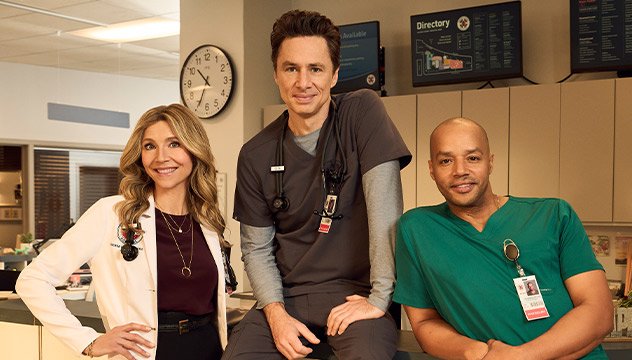
The 2026 revival brings J.D., Turk and Elliot back as experienced doctors. ABC’s current series description places them alongside a new generation at Sacred Heart, with Zach Braff, Donald Faison and Sarah Chalke returning. That reversal—from needing guidance to having to provide it—is a good reason to revisit what made the original work.
A friendship that did not need to apologize for itself
J.D. and Turk were allowed to be extravagantly affectionate. They had rituals, private jokes, questionable dance moves and an almost competitive enthusiasm for spending time together. Their friendship was not background texture between romantic storylines. It was one of the show’s central relationships.
Donald Faison gave Turk an appealing confidence without making him invulnerable. Beside J.D.’s spiraling imagination, he could seem like the person who knew exactly who he was. Then work, marriage or a difficult decision would expose a less certain version of him.
That balance helped the comedy survive its broadest moments. The jokes could be absurd because the relationship underneath them was recognizable: the friend who knows your entire embarrassing history and still answers the phone.

The fantasies were a way of thinking
Many sitcoms stop the action for a punch line. Scrubs could stop reality itself. A passing remark might become a miniature movie inside J.D.’s head, complete with costumes, impossible logistics and a level of commitment wildly disproportionate to the situation.
Those digressions worked best when they exposed his fear or vanity. He wanted to be admired, wanted to be a good doctor and wanted difficult feelings to arrange themselves into a story he understood. His imagination kept offering easier versions of the problem. The hospital kept refusing them.
The Peabody Awards recognized the series in 2006. Its citation links the inventive style to the show’s attention to ethical questions and human vulnerability. That is a useful way to describe the appeal: its visual silliness could make a serious point easier to approach.

Sacred Heart felt like a workplace
The hospital had hierarchies, grudges, routines and people who understood how it actually ran. Carla’s competence mattered. Elliot’s ambition came with anxiety. The Janitor could turn an ordinary journey down a corridor into a private ordeal. Everyone occupied the same building, but nobody experienced quite the same institution.
That made the setting more than an interchangeable collection of beds and white coats. Staff knew which door to avoid, which person needed persuading and which rule would suddenly become important. Familiar spaces accumulated stories, just as they do in any long-term workplace.
The photograph below shows the former North Hollywood Medical Center during demolition in 2011. Seeing a recognizable television location stripped back to an ordinary building is a peculiar experience: a place that seemed endlessly available on screen had a finite life outside it.

Dr. Cox could be right and still be difficult
John C. McGinley’s Dr. Cox was a formidable engine for insults. The length and precision of a rant could be a joke in itself. But the character would have been tiring if being abrasive were his only quality. His care for patients and colleagues continually complicated his refusal to speak gently.
The show did not always get that balance right. Some workplace behavior and jokes feel harsher now, and viewers need not excuse every old punch line to appreciate the series. The stronger scenes let another character challenge him, or showed that a good intention did not erase the damage of a bad delivery.
For J.D., growing up meant learning from Cox without treating him as an answer key. A mentor could give valuable advice and still be a person with unresolved problems. That is a more interesting relationship than a wise teacher delivering the lesson of the week.

When the music arrived, the jokes did not disappear
A Scrubs montage could gather several apparently unrelated stories into one emotional movement. A song, an unfinished conversation and a quiet look might connect characters who had spent most of an episode irritating one another.
Sometimes the technique was conspicuous. You could feel the show preparing to hurt your feelings. Yet the best sequences earned their emotion through details planted earlier, while the audience was busy laughing. The sadness did not cancel the comedy; it revealed what the comedy had been protecting.
Returning as the people who have to know
The revival’s premise changes the original question. What happens when the former junior doctors are now the people younger staff look toward? Experience can provide judgment without providing certainty, and a familiar friendship can mean something different after years of responsibility.
ABC scheduled the revival’s second-season premiere for September 30, 2026, in its fall schedule announcement. That date has passed as of this article’s October 7 update. This piece is a retrospective on the original show and its return, rather than a review of episodes we have not independently evaluated.
The lasting invitation is simple enough: come back for the ridiculous friendship, then notice how much the hospital asks of the people inside it. If you are revisiting the broader era, our Malcolm in the Middle retrospective explores another comedy that understood how funny a life without control could be.