The Game Boy Camera could turn a perfectly normal face into a suspicious collection of squares. A shadow ate one eye. A grin became a tiny monster. By the standards of a good portrait, things were going badly. As a game, it was getting interesting.
Its rough pictures gave you something to mess with. A familiar person could become a sprite; a boring corner could look like a strange new place. The fun was in seeing what survived the reduction, then deciding what to do with it.
A camera that occupied the cartridge slot
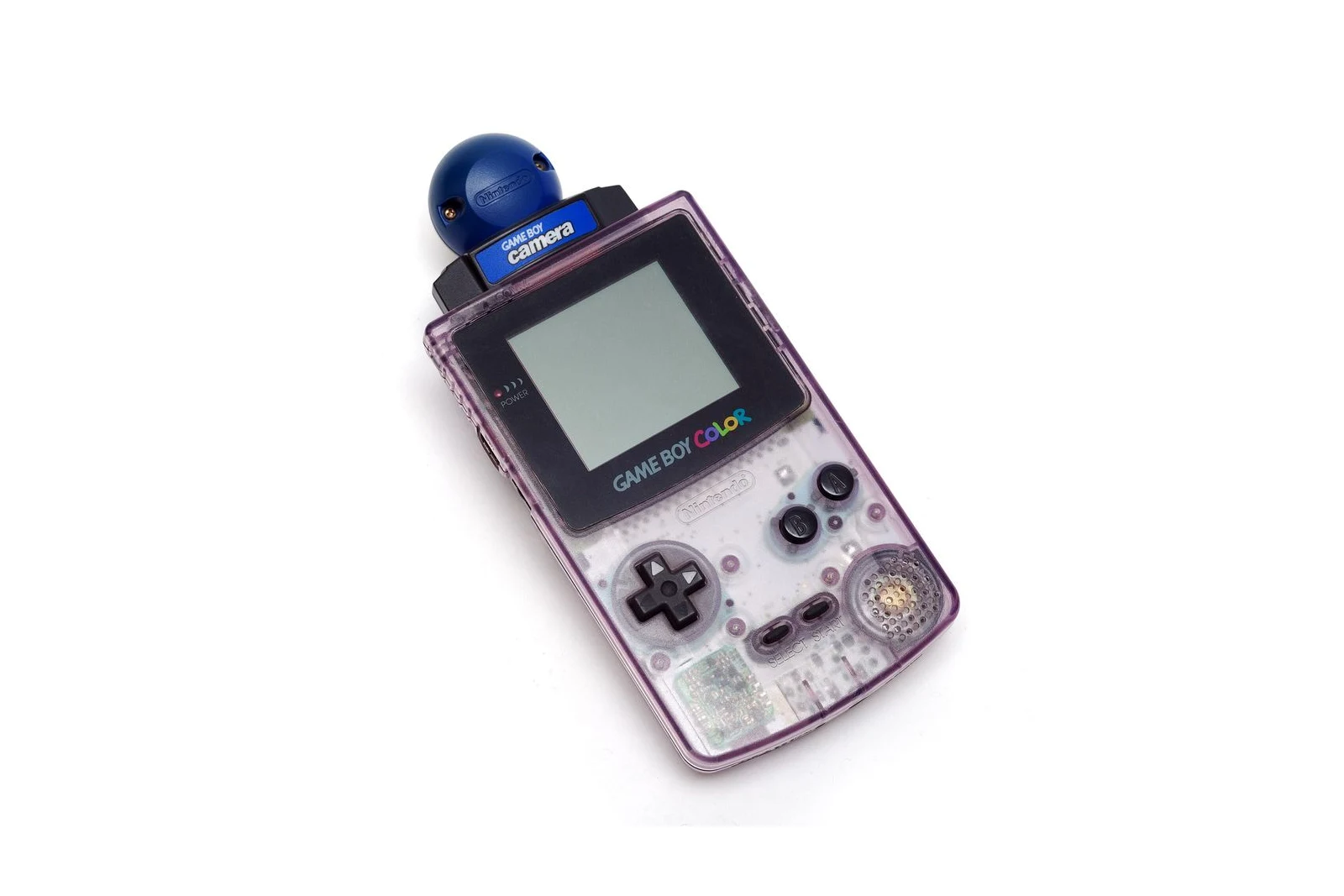
The Game Boy Camera plugs into the handheld’s cartridge slot, with its lens assembly sticking out above the machine. The photograph here shows it on a Game Boy Color; the accessory also belongs to the earlier monochrome Game Boy family.
Nintendo’s original support description emphasizes taking monochrome pictures, then using built-in tools to alter them and add Nintendo characters. It describes a creative activity inside the handheld, rather than promising the qualities of a conventional camera.
The physical arrangement helps explain the difference. You hold a game console, look at its screen, and use its controls to make a picture. The same object that normally displays a world built by someone else now asks you to supply the subject.
Low detail changes what you notice
In a detailed photograph, tiny textures can carry the image: hair, lettering, fabric, reflections. In a heavily simplified image, large shapes have to do more of the work. A face near the camera is easier to recognize than a face lost in a busy room.
That makes the Game Boy Camera an interesting way to think about composition. A strong silhouette matters. The direction of the light matters. A cluttered background may merge with the subject instead of politely staying behind it.
You can read those limitations as problems to correct, or use them as the rules of a visual game. What happens if a lamp moves to the other side? How close can an object get before it becomes a pattern? Which household item looks like a landscape when most of its detail disappears?
Those questions remain interesting even when the camera producing them is technically obsolete. Better resolution would create a different exercise, not automatically a more enjoyable one.
The picture was material for another activity
Nintendo’s editing tools made the capture itself only part of the experience. A photo could be altered, decorated, and made deliberately ridiculous. The important result did not have to be an accurate record of what had stood in front of the lens.
This is a useful distinction from the family camera. A family photograph often comes with an expectation that everyone will look presentable and the event will be documented properly. A toy camera can invite experimentation precisely because nobody expects it to produce the official picture.
It also lowers the emotional cost of a failed shot. When the whole device encourages play, an awkward result can be something to keep working on. The odd face in the image may be the beginning of the joke rather than the reason to delete it.
The printer made the pixels physical
The optional Game Boy Printer offered an unusually satisfying final step. Nintendo’s printer documentation explains that it uses heat on special paper to create grayscale images and connects by link cable. It can print camera photographs and output from compatible games.
A tiny print changes the social life of a digital picture. You can pass it to someone without passing over the console. It can end up in a notebook or a small collection of things that were never meant to become an archive.
There were still material constraints: paper, power, and a separate accessory. But the reward was unusually direct. Something captured through a plastic lens could emerge as an object you could hold a moment later.
Keep the weird one
The wrong test is whether a Game Boy Camera can replace a modern phone. It cannot provide the clarity, speed, or convenience people reasonably expect from everyday photography.
A more interesting test is whether it makes you look differently. Try imagining a three-picture assignment: one recognizable face, one object made mysterious, and one scene that depends on shadow. Each demands a choice beyond pressing a shutter.
That is why the pictures can feel worth keeping despite their obvious limitations. They show both the subject and the peculiar machine through which you chose to see it. The imperfections are not incidental damage to the memory. They are part of its appearance.
Keep exploring
- Why 2000s Digital Cameras Are Finding a New Generation
- Tamagotchi: The Tiny Virtual Pet That Took Over the World
Hero photograph: Game Boy Camera 7996.jpg by Ashley Pomeroy. CC BY-SA 4.0. Resized and padded for this page; photograph otherwise unchanged.