Cover: Official Switch 2 Ocarina of Time promotional image, © Nintendo. Image source.
The notes can be right and the place can still feel different. Bring an ocarina closer, let its last note hang in the air or fill a quiet pause with a voice, and familiar Hyrule changes around your ears.
Ocarina of Time’s remake raises a question about listening, not just bigger arrangements. Nintendo’s announced orchestral music and voice acting offer new ways to shape a scene. The interesting test is what they leave room for: footsteps, the environment and the small instrument in Link’s hands.
Nintendo lists the Switch 2 release for November 5, 2026. This analysis was written ahead of the November 5 release, using announced features and documented earlier sound design. It is not a review: we have not played or measured the finished remake.
This argument has happened inside Nintendo before
When the team revisited the score for Ocarina of Time 3D, Mahito Yokota initially pursued more updated arrangements. In Nintendo’s 2011 sound-team interview, he recalls Koji Kondo asking for closer fidelity to the N64 sound after work was already underway.
The exchange matters because both positions are understandable. New hardware offers an opportunity to change the presentation. A familiar sound also carries information the player may not be able to describe: distance, expectation and the feeling of a place.
That gives the 2026 remake a more interesting question than whether an orchestra is an upgrade. What is each change trying to preserve, and what is it trying to make different?
Hyrule Field was already listening to the player
Nintendo’s discussion of Hyrule Field describes normal, battle and quiet musical patterns. The music could respond to the situation rather than behaving like one fixed recording laid over every journey.
That is a structural feature. A recording with more instruments does not, by itself, tell us whether a game responds gracefully when you stop, turn or enter danger. The arrangement and the system deciding when to use it are separate questions.
The practical listening test is to change your behavior. Cross a familiar area, stop for a while, then pay attention when the situation changes. You are listening for the way the game acknowledges your actions. The tune matters, and so does its timing.
SIGNAL LAB / OPTIONAL LISTENING
One phrase, two senses of space
Play a short, original five-note phrase close up, then with simple reflections. The notes and timing stay the same. Listen for where the sound seems to sit.
Silent until you press play. Use a comfortable listening volume.
Original synthetic demonstration, not Zelda music, an N64 emulation or a reconstruction of either remake’s audio. Adding reflections changes more than perceived distance; real mixes involve many other choices.
A small adjustment can change the opening’s distance
In another part of the interview, Yokota describes a revealing problem with the 3DS title music. The ocarina seemed too prominent; the discussion turned to missing reverberation and the impression of an instrument heard from a distance.
It is a wonderfully precise example of why fidelity cannot be judged by recognizing the notes alone. A melody can be correct while its position in the imagined scene feels different.
The demonstration above isolates a modest part of that idea using newly made tones. It is a listening aid, with none of the game’s recordings. A new arrangement can still feel intimate or distant, delicate or crowded; the number of instruments cannot settle that choice.
Voice acting changes who controls the pause
The original has vocal reactions, musical voices and other character sounds. The new announcement therefore should not be described as adding the first human vocal sound to a previously silent world. The confirmed change is voice acting within the rebuilt presentation.
A line of text allows a reader to dwell, skim or imagine a delivery. A performed line supplies its own stress, rhythm and breath. That can clarify a character and make a scene more immediate. It can also change the amount of space a player has to inhabit the moment.
Our question for the finished game is whether the performances and scene direction work with player attention. We are not inferring that Link delivers full spoken conversations, that every line is voiced, or that an unannounced reading option exists. Those details require evidence from the release.
The instrument still has a job to do
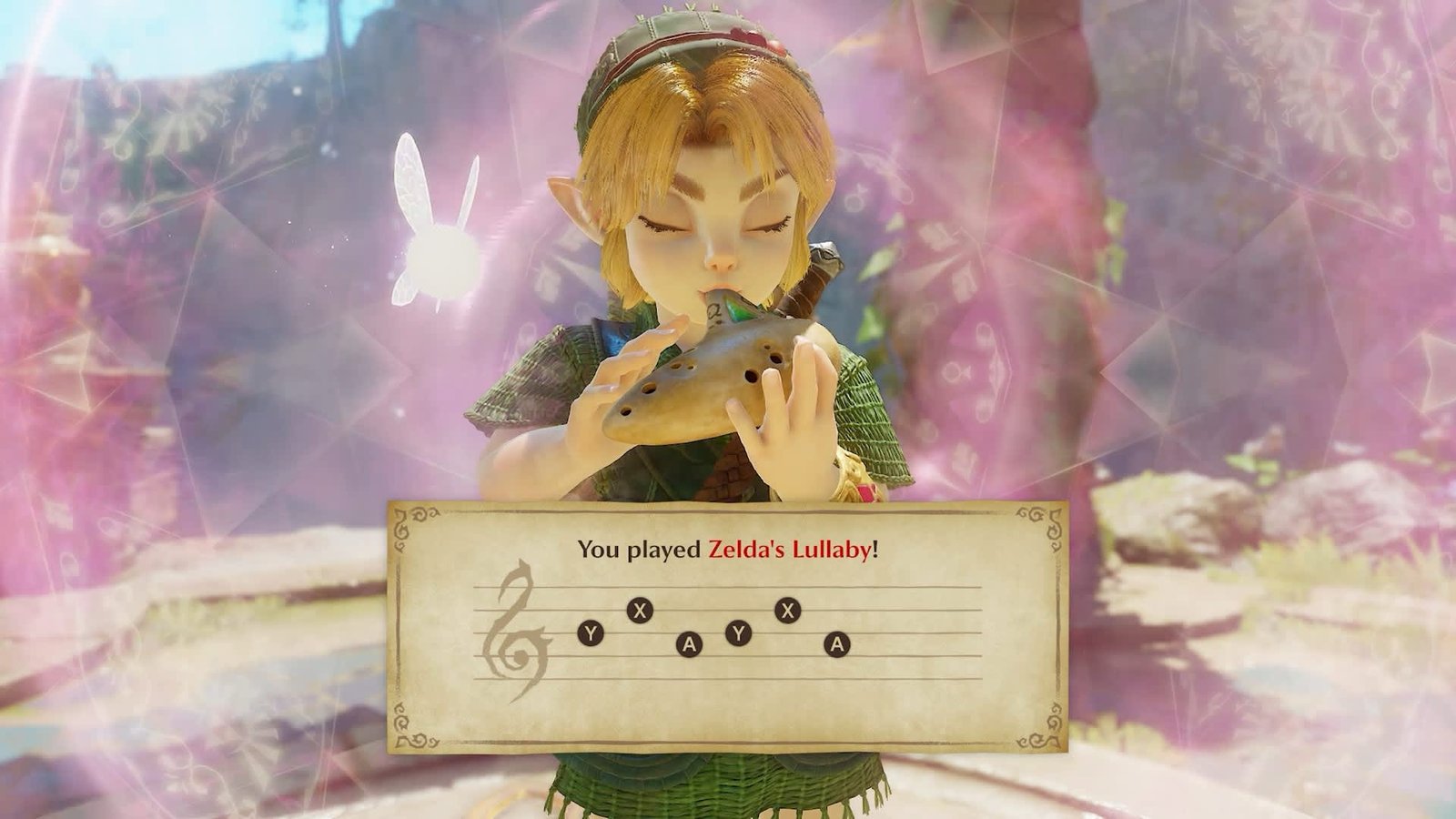
The ocarina is both a sound source and an action. A familiar short melody can mean that a route opens, a connection is recognized or the world changes. That makes remembering a song feel useful inside the fiction.
Nintendo’s current product page shows traditional button input alongside microphone-based playing. The attraction is easy to understand: the small performance becomes more bodily. How forgiving that input feels, which accommodations it offers and whether it is comfortable in a noisy room are questions for actual testing.
The musical response also matters. After your brief input, the game answers with its own presentation. The shift from something you perform to something the world recognizes is part of the satisfaction. An elaborate arrangement should still leave that exchange readable.
SIGNAL LAB / KEEP THIS LISTENING CARD
Three things to listen for when you play
1. Does the music react?
Pause your movement in a safe place. Listen for what the game does with that stillness, then compare it with travel or danger. Do not infer an entire adaptive system from one trailer transition.
2. Can a small sound still matter?
Notice the instrument, footsteps and environmental cues beside the score. Clear does not have to mean loud; a mix can create room through timing and restraint.
3. Do conversations leave breathing space?
Pay attention to the arrival and ending of a voiced line. Does it give the scene a rhythm you want to remain inside? Accessibility options and reading controls should be checked in the finished release.
Leave room to hear yourself arrive
A soundtrack album fixes its own sequence. A game’s sound must also respond to the player wandering off, stopping at an unexpected moment and looking at something the composer did not choose. Ocarina’s history offers unusually good reasons to listen for those interruptions.
The remake may produce a more expansive performance of music people already love. The deeper question is whether it also preserves the feeling that the world has noticed you arriving. Those are the listening questions this analysis leaves open; answering them requires checking the finished release.
Follow the signal
- The confirmed Ocarina of Time remake context — keep announcement facts separate from this focused audio argument
- How the N64 made room for a new dimension — revisit the platform behind the original world
- Seven sounds that became memories — explore how tiny functional sounds can outlast their machines
Sources and editorial notes
- Nintendo: Switch 2 Ocarina of Time — release, announced audio presentation and microphone input
- Iwata Asks: Hyrule Field — documented musical responses
- Iwata Asks: revisiting the N64 sound — the 3DS arrangement discussion
- Iwata Asks: the distant ocarina — the title-music and reverberation example
Announcement facts checked October 29, 2026. Critical questions are NostalgiaSignal’s analysis, not claims about unplayed content. The optional tone illustration is original and runs locally after a click; it records nothing and sends no audio. Promotional image © Nintendo.