A good action scene makes you understand the danger before it asks you to admire the spectacle. You know where the truck is headed, how far the roof is from the next building, or why the person on screen cannot simply walk away.
These five films from 1991 offer very different versions of that clarity. Our ranking favors spatial storytelling, physical performance, variety and the urge to watch a sequence again. It is an editorial selection, not a box-office table or a claim that every viewer should rank them the same way.
We use the films’ original release year. That matters for Operation Condor, which reached American theaters later. Some of these are violent, adult films; they do not make an interchangeable family movie-night set.
THE NOSTALGIA FILES / LOOK CLOSER
What kind of action are you in the mood for?
- Invention and pulp adventure: The Rocketeer makes learning to control the machine part of the fun.
- A space that keeps becoming unsafe: Backdraft builds spectacle around obscured routes and changing rooms.
- Physical comedy: Operation Condor turns an awkward environment into a chain of problems and solutions.
- A pursuit with emotional consequences: Point Break makes attraction and duty pull in different directions.
- Heavy machines and clear stakes: Terminator 2 lets us understand the danger before admiring the effect.
These are editorial routes into the five films, not interchangeable age recommendations. Check local classifications before choosing for younger viewers.
5. The Rocketeer: the thrill of barely controlling the machine
Joe Johnston’s adventure finds a wonderfully direct source of suspense: strapping a rocket to your back is an exceptionally bad idea until you work out how to steer. Cliff Secord’s experience as a pilot helps, but it does not eliminate the possibility of an embarrassing or disastrous landing.
The helmet, jacket and machinery give the fantasy a satisfying weight. The film’s period setting makes its technology feel handmade and experimental. You can admire the design while still believing that it could fail.
Disney’s retrospective identifies the 1991 film and its basis in Dave Stevens’ comic. The movie’s continuing appeal is less about an elaborate mythology than a clean adventure premise: an ordinary person gets an extraordinary device, and powerful people want it back.
Watch for: how uncertainty about the jetpack turns a heroic pose into a physical problem. The character has to earn the image.
4. Backdraft: every doorway can change the scene
Ron Howard gives fire an aggressive screen presence. It fills space, hides information and changes the meaning of an ordinary room. The family drama can become emphatic, but the burning interiors have an immediate sensory force.
The movie is a dramatic fantasy about firefighting, not an instructional account of the profession. Its flames are staged and edited to express threat. Reading it as a safety demonstration would miss both its purpose and its exaggerations.
What matters cinematically is how light, smoke, sound and performance make the characters’ surroundings unstable. A route that seemed available a moment earlier can become impossible. The action depends on the room rather than simply happening inside it.
Watch for: the way the film delays a clear view. Not seeing the whole space can create suspense when the audience understands why visibility matters.
3. Armour of God II: Operation Condor: movement becomes comedy
Jackie Chan turns a treasure-hunting adventure into an argument about what a body can do with an inconvenient environment. Furniture, machinery and changes in height become opportunities for a gag as well as obstacles.
The New York Asian Film Festival’s program lists the Hong Kong film as a 1991 production directed by Chan. Its later American release can make it seem out of place in a 1991 list, but the original year is the relevant one here.
Chan’s comic action often gives us enough time to see the idea form. An object offers a possible escape; the escape creates another problem; the next movement turns the problem into a joke. The pleasure comes from following the chain, not merely registering impact.
Watch for: the final wind-tunnel sequence, where the environment changes what even a simple movement requires. The spectacle and the joke are the same event.
2. Point Break: the chase is the relationship
Kathryn Bigelow’s crime film makes Johnny Utah’s attraction to Bodhi’s world part of its action. Surfing and skydiving are not decorative hobbies attached to a police plot. They express the freedom Utah is investigating and increasingly wants to understand.
Keanu Reeves and Patrick Swayze give the conflict different kinds of intensity. Utah has an assignment; Bodhi has a philosophy that makes risk sound like revelation. Their connection makes the pursuit harder to resolve than a simple question of catching the criminal.
The foot chase remains a model of consequential obstacles. Fences, rooms and tight turns keep changing what the pursuer has to do. Exhaustion feels cumulative. The viewer understands the effort because the geography stays meaningful.
Watch for: how the film allows admiration and alarm to coexist. Bodhi’s charisma does not make the consequences of his choices disappear.
1. Terminator 2: Judgment Day: impossible effects, readable danger
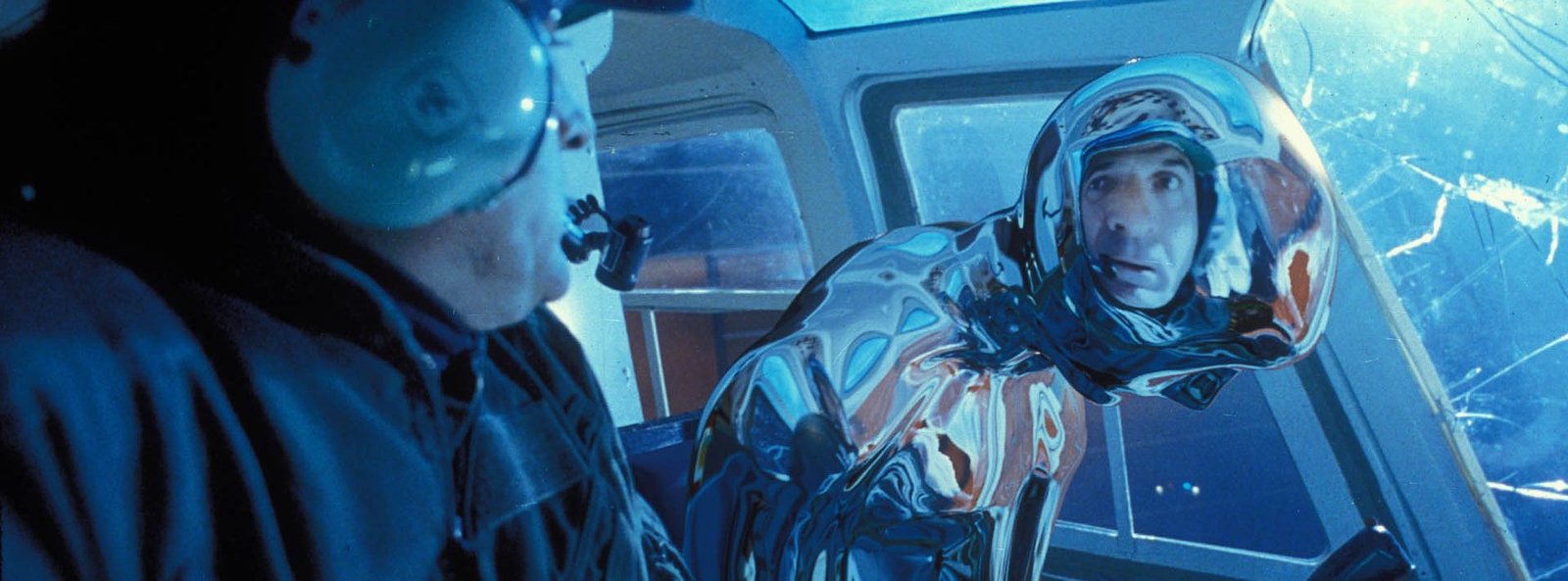
James Cameron’s sequel uses two machines to establish two different sets of expectations. One has obvious weight. The other can violate the shape of a human body. Their contrast makes a chase understandable before anyone explains the technology.
Industrial Light & Magic identifies the film as a landmark in using computer graphics for a principal character. That achievement works because the surrounding movie keeps giving the impossible something tangible to collide with.
Vehicles have momentum. Corridors restrict movement. The steelworks offers both threat and opportunity. The visual effects do not free the director from explaining where everyone is; they make that explanation more important.
Watch for: how each major location changes the options available to the characters. The action develops through the space rather than using it as anonymous background.
THE NOSTALGIA FILES / LOOK CLOSER
Look closer: three roles in Terminator 2’s canal chase
Sequence spoilers. In the canal pursuit, John’s small bike, the pursuing truck and the T-800’s motorcycle give the viewer three immediately different problems.
John: keep moving
The bike makes his vulnerability visible. He needs a route out while the distance behind him closes.
T-1000: take the space
The truck’s size turns the channel into a trap. Its path and momentum are threats the viewer can read.
T-800: change the formation
The motorcycle can move alongside and intervene. Protection becomes a change in position rather than an explanation in dialogue.
This is an original breakdown of screen roles, not a production map or stunt instruction. The canal sequence excerpt lets you follow the changing distances. Notice how the concrete walls and relative vehicle sizes make a rescue or collision understandable even between cuts.
A strong year because the films were different
The five choices range from warm pulp adventure to industrial science fiction. Their shared quality is not a rejection of digital effects or an assumption that the past was more authentic. It is attention to what a movement means.
That quality survived the trip from theater to VHS. Even on a small television, a viewer could follow the route, anticipate the collision and rewind to see how the scene had been constructed. Thirty-five years later, that remains a persuasive reason to press play.
Updated October 26, 2026: Added a viewing guide and an analysis of the canal chase in Terminator 2.