Cover: Original Ocarina of Time environment, © Nintendo; archive screenshot via Zelda Wiki. Image source.
Kakariko has houses, a windmill and people with ordinary concerns. The well belongs to that picture: a useful thing a village would have. Then the water drains, and a familiar part of the scenery becomes an entrance.
The Bottom of the Well is frightening because it makes familiar things unreliable. A wall can be a passage. A floor can fail to be solid. A small village contains a space that does not share the village’s reassuring appearance. You are trying to navigate while losing confidence in the act of looking.
This is an analysis of the original Ocarina of Time, not a report on the unreleased Switch 2 remake. The opening discusses the location’s basic premise. The creature and reward are hidden behind a clearly marked spoiler section.
The village teaches you what feels ordinary
Horror needs an expectation to disturb. Kakariko supplies one through recognizable structures: a settlement, a windmill, doors, paths and a well. Even when a fantasy world is unfamiliar, these forms suggest uses a player can understand.
The entrance works because it changes that reading. The well is no longer only a surface detail. It extends downward, and you can follow it. You have not traveled to a distant evil kingdom; you have discovered that the place you already knew had another depth.
That relationship is more unsettling than a warning sign outside a separate horror level. The normal village continues to exist. The underground space becomes something it was possible to overlook.
A short descent changes the scale
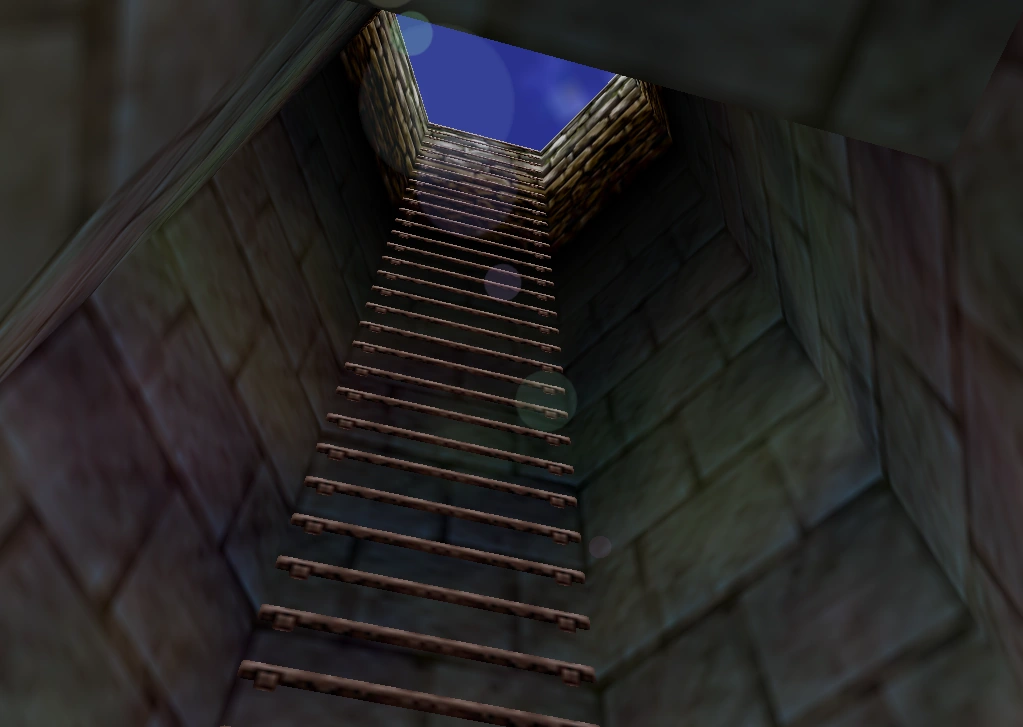
The ladder gives the transition a direction. Above is daylight and a place with a name. Below are narrow passages and surfaces you have to investigate. Returning would require going back through the same small opening.
Child Link also changes how those passages read. A low crawlspace brings the camera close to stone, and the small figure makes the surrounding structure feel less negotiable. Movement that is ordinary elsewhere can become exposure here.
The effect does not need a long cinematic. The player performs the descent, the approach and the decision to continue. That is why an entrance can do so much of the frightening work.
SIGNAL LAB / ONE SIMPLE TRICK
Would you trust this wall?
A wall seems to close the way. Open the panel below to look again. This original drawing illustrates a design principle; it is not a dungeon map or a playable copy of Zelda.
Look again: the surface may be lying
When a visible boundary is unreliable, every similar boundary becomes a question. You spend attention checking the room instead of simply crossing it. The well turns uncertainty about appearance into part of moving through the space.
The real threat is uncertainty about the room
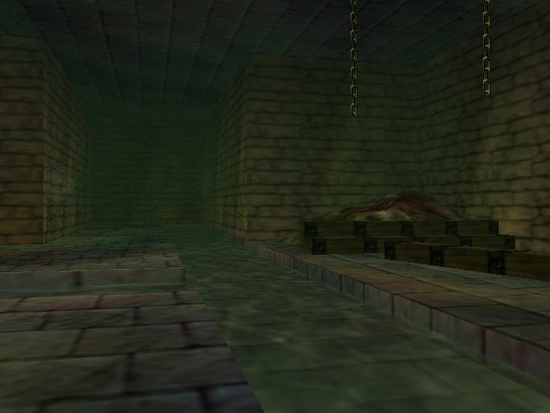
An ordinary dungeon teaches rules: this looks like a wall, that looks like a floor, this door is the way onward. The well unsettles that confidence with concealed passages and deceptive surfaces.
The player then has two tasks. One is solving where to go. The other is deciding which information deserves belief. That second task makes a short crossing feel longer; the room no longer supplies a reliable answer at first glance.
The effect is especially sharp in a game that usually makes exploration inviting. Recognizing a new path often means progress. Here, a discovery can also mean that the room was less safe than you thought.
Sound keeps the empty parts occupied
A narrow view cannot tell you everything about an underground chamber. The sound has room to imply more than the frame confirms. Sustained tones, unsettling timbres and the possibility of something outside the view make quiet travel feel watched.
The important question is not how many noises the game can play. It is what the player can confidently locate. A clear musical tune gives attention a pattern to follow; an uneasy texture can leave that attention searching for a source.
That is a critical reading of the scene, not a claim that every player is frightened by the same sound or that a specific studio recording trick has been documented. The physical setting and the uncertainty about its boundaries are enough to explain why the atmosphere can persist between encounters.
SIGNAL LAB / OPEN ONLY IF YOU WANT TO KNOW
Spoilers: what waits below
Reveal the creature, the reward and why they fit together
Dead Hand turns the area’s uncertainty into a bodily problem. The grasping hands make the floor look occupied before the larger creature reveals itself. Being caught changes the player’s immediate concern from reading the room to getting free.
In the normal quest, defeating it leads to the Lens of Truth. The reward is unusually well matched to the location’s central anxiety: you obtain a way to investigate appearances in a place that has made appearances unreliable.
That connection gives the encounter a purpose beyond shock. The frightening place teaches the need for a tool, and the tool answers that need. The reward does not erase the memory of having crossed the room without being able to trust it.
What this means for the remake
Nintendo lists the Switch 2 remake for November 5, 2026. New presentation creates an opportunity to revisit the location, but the precise treatment of this whole section is not established by the material used for this article.
Our question for a future playthrough is about legibility. Better visibility might make a surface easier to read, while a closer camera or more spatially distinct sound could create different kinds of tension. Those are possibilities to investigate after release, not changes we are claiming have happened.
The original’s lesson remains useful: fear can come from withdrawing a simple certainty. Once you stop trusting the walls, an otherwise empty passage has enough to do.
A different way to revisit it
If you replay the original, first notice the transition from the village to the shaft. Pay attention to what remains visible behind you and which surfaces you are expected to accept. You do not need to turn up the volume, invent a childhood story or force yourself through a frightening encounter to recognize the design.
The well works because it was already part of a place that seemed familiar. The route downward asks an uncomfortable question: what else have you been walking past without really seeing?
Follow the signal
- The wider return to Ocarina of Time — read the confirmed remake context separately from this original-location analysis
- Choose a Halloween game night — find lighter haunted spaces as well as full survival horror
- Why opening a door in Resident Evil feels dangerous — compare another game that turns a transition into tension
Sources and editorial notes
- Thonky: original quest route — illusion, Dead Hand and reward sequence; route cross-check rather than prose template
- Zelda Wiki: Bottom of the Well — location, original-game imagery and edition identification
- Nintendo’s remake product page — current release context only
Original criticism by NostalgiaSignal. Specific mechanics were cross-checked against documented normal-quest routes; Master Quest, randomizers and the unreleased remake are not treated as identical layouts. The illustration is conceptual. Game images © Nintendo.